Just learning here and trying to tidy up my wiring in van have a couple of questions as follows
1) Should I put a Isolation switch between Panels and Victron controller. ?
2) Put a fuse between Victron controller and Battery ?
Any advise will be appreciated
Paul
Whenarewethere said
08:23 AM Aug 2, 2021
I have a switch between panels & my Victron 100/20 & can also isolate individual sets for testing to chase down potential performance issues.
I have a fuse between the controller & battery.
Tony Bev said
01:57 PM Aug 2, 2021
I am not a techie, but I am led to believe that it is important to have fuses
As I have a DC/DC controller (this allows the engine battery, and solar panels) to charge the house batteries
Plus I have solar on the roof, as well as a portable solar panel, I use circuit breakers
A circuit breaker can be used for both isolation and fuse application
Mine are set up between
Solar panel and controller Controller and house battery House battery and house wiring
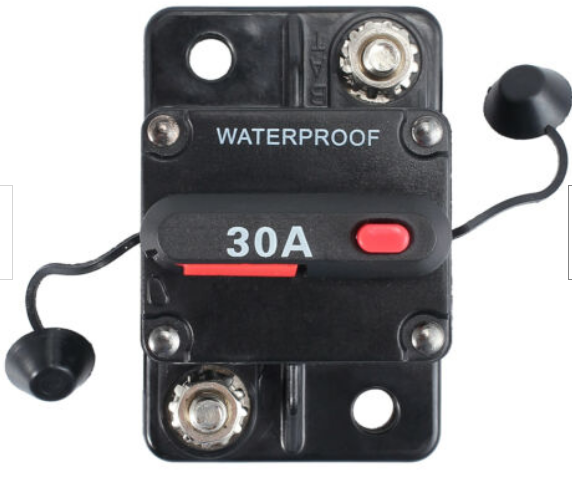
Below is a pic of a circuit breaker, and you can buy them in different amps, I buy mine from eBay
Peter_n_Margaret said
02:11 PM Aug 2, 2021
There is absolutely no point in having a fuse or circuit breaker between the solar panels and the controller. The panels could never blow that fuse because they are effectively a constant power source.
We don't have an isolation switch between the panels and controller either. In the rare event of needing to disconnect the solar I can simply remove the cable from the controlled. A switch is just another loss in the system.
A fuse between the controller and the batteries (close to the controller) is arguable in case of a short to earth of that cable. We don't. The controller needs to be as close to the batteries as possible.
Cheers,
Peter
Aus-Kiwi said
03:52 PM Aug 2, 2021
I dont . I just isolate out of link box if required . With parallel system, theres 4 wires going into reg which wont fit . So all + from panels active link then one heavy wire goes to reg which just fits into connector. . From memory 6mm sq..
Dick0 said
04:59 PM Aug 2, 2021
Hi Paul,
I have an isolator on volts positive (+V) between solar panels and solar controller.
I have an isolator on volts positive (+V) to battery bank.
Why?
Any wiring alterations I need to make in the system, I can isolate all volts positive (+V) input to the batteries.
Insofar as fuses, the solar controller is protected internally from shorting. All other utility devices such as fridge, air heaters, water heaters, lights, 12v power outlets should be fuse protected.
12v tug to den connection, if fitted correctly, will also be fuse protected in engine bay.
Never over fuse a circuit (several fuses on same circuit) as each fuse can cause voltage loss. And if there is a failure on that circuit...which fuse has failed?
Peter_n_Margaret said
05:33 PM Aug 2, 2021
Dick0 wrote:
Never over fuse a circuit (several fuses on same circuit) as each fuse can cause voltage loss. And if there is a failure on that circuit...which fuse has failed?
ANY cable which has a power source (battery) at each end (like a DCDC connection) needs to be fused at each end as a short in the middle is a short to a battery and that is a disaster because of the huge currents that can flow.
It is also legitimate to have a branch power feed (larger fuse near the battery) which then divides into smaller feeds to various things. Each of those branches should be separately fused according to the cables.
Fuses and circuit breakers are to protect the cables from overload (and fire). They are not to protect the appliance.
Cheers,
Peter
Paulp said
05:34 AM Aug 3, 2021
Great information from all that have responded
Thanks
Paul
peatop said
10:35 PM Aug 4, 2021
Hi guys, new to here not new to solar but not done any for maybe 30 years so doing an awful lot of learning atm. I cam across a video on youtube about this subject today although this is from the USA it did make some sense to me, have a look and post your comments ;) www.youtube.com/watch
Hi all
Just learning here and trying to tidy up my wiring in van have a couple of questions as follows
1) Should I put a Isolation switch between Panels and Victron controller. ?
2) Put a fuse between Victron controller and Battery ?
Any advise will be appreciated
Paul
I have a switch between panels & my Victron 100/20 & can also isolate individual sets for testing to chase down potential performance issues.
I have a fuse between the controller & battery.
I am not a techie, but I am led to believe that it is important to have fuses
As I have a DC/DC controller (this allows the engine battery, and solar panels) to charge the house batteries
Plus I have solar on the roof, as well as a portable solar panel, I use circuit breakers
A circuit breaker can be used for both isolation and fuse application
Mine are set up between
Solar panel and controller
Controller and house battery
House battery and house wiring
Below is a pic of a circuit breaker, and you can buy them in different amps, I buy mine from eBay
We don't have an isolation switch between the panels and controller either. In the rare event of needing to disconnect the solar I can simply remove the cable from the controlled. A switch is just another loss in the system.
A fuse between the controller and the batteries (close to the controller) is arguable in case of a short to earth of that cable. We don't. The controller needs to be as close to the batteries as possible.
Cheers,
Peter
Hi Paul,
I have an isolator on volts positive (+V) between solar panels and solar controller.
I have an isolator on volts positive (+V) to battery bank.
Why?
Any wiring alterations I need to make in the system, I can isolate all volts positive (+V) input to the batteries.
Insofar as fuses, the solar controller is protected internally from shorting. All other utility devices such as fridge, air heaters, water heaters, lights, 12v power outlets should be fuse protected.
12v tug to den connection, if fitted correctly, will also be fuse protected in engine bay.
Never over fuse a circuit (several fuses on same circuit) as each fuse can cause voltage loss. And if there is a failure on that circuit...which fuse has failed?
ANY cable which has a power source (battery) at each end (like a DCDC connection) needs to be fused at each end as a short in the middle is a short to a battery and that is a disaster because of the huge currents that can flow.
It is also legitimate to have a branch power feed (larger fuse near the battery) which then divides into smaller feeds to various things. Each of those branches should be separately fused according to the cables.
Fuses and circuit breakers are to protect the cables from overload (and fire). They are not to protect the appliance.
Cheers,
Peter
Thanks
Paul