I had a roof platform which I totally rebuilt to fit the car which was great for standing on the roof to take photos. Beyond that it is probably the most pointless accessory for a car.
The issue is payload. I chucked out the roof platform & have a net payload gain of 16kg. Roof platform out, 2 additional crossbars in, 4 in total. Nevertheless we have tried our very best to reduce weight as much as possible. Aluminium fuel holders are half the weight of steel holders.
I don't own a chainsaw!
This is the best aerial view I have complete with the only spare tyre (road) I could buy in the outback after destroying a tyre.
Custom built (six x 20 watt Projecta) folding solar panels sit behind spare wheel. 10 x 50mm flat bar brackets bent to lower height. The front panel is free in bugs. We do put the solar panels in the car for corrugated roads & use up the fuel as quick as possible to reduce weight on the roof. Total mass including roof rails, fuel, sand tracks & awning is 142kg. A pair of Land Rover cross bars can take 75kg gross weight & pair of heavy duty third party cross bars on Land Rover rails can take 100kg.
A few photos of the custom aluminium fuel holders to hold four 10L containers. 10L is the maximum size I want to get on & off the roof while standing on the car's rear wheel.
I have used anodised aluminium & 316 stainless M6 Allen bolts with Nyloc nuts. Every hole in the aluminium was tapped as well. 3 x 20mm 316 stainless bar in crossbar captive channel, M6 tapped holes for bolts.
Brackets off the back to hold sand tracks, 25 x 3mm anodised square hollow section. Lots of M4 & some M6 bolts & 316 stainless bracing.
Hinges with covers from Whitworths Marine. Custom wing nuts & plastic alignment blocks to screw down sand tracks.
Two additional 5L fuel containers inside the spare wheel. Two 10L do fit in this space but with 5L I could have two quick release brackets. (the hole in the centre was for an earlier clamping down design which I have redesigned)
Bracket to bolt spare wheel down (there is a safety pin in the bottom of the bolt, but not shown in this photo).
The aluminium bar is 5083 structural alloy drilled out to reduce weight.
I drew up an elevation drawing 1:1 scale of the entire roof setup to get spacing exactly right. Drawing up the setup solved a lot of issues & as a result saved a lot of money.
It's far cheaper to solve problems on a drawing. A pencil & sticky taping A4 paper together saves a lot of money.
KJB said
12:00 PM Jul 20, 2021
Whenarewethere wrote:
I had a roof platform which I totally rebuilt to fit the car which was great for standing on the roof to take photos. Beyond that it is probably the most pointless accessory for a car.
The issue is payload. I chucked out the roof platform & have a net payload gain of 16kg. Roof platform out, 2 additional crossbars in, 4 in total. Nevertheless we have tried our very best to reduce weight as much as possible. Aluminium fuel holders are half the weight of steel holders.
All nice work - well planned and executed (nice pics. too...) , Congratulations , you would have had a lot of satisfaction from this Project .....and will continue to enjoy the benefits of it.
KB
I don't own a chainsaw!
This is the best aerial view I have complete with the only spare tyre (road) I could buy in the outback after destroying a tyre.
Custom built (six x 20 watt Projecta) folding solar panels sit behind spare wheel. 10 x 50mm flat bar brackets bent to lower height. The front panel is free in bugs. We do put the solar panels in the car for corrugated roads & use up the fuel as quick as possible to reduce weight on the roof. Total mass including roof rails, fuel, sand tracks & awning is 142kg. A pair of Land Rover cross bars can take 75kg gross weight & pair of heavy duty third party cross bars on Land Rover rails can take 100kg.
A few photos of the custom aluminium fuel holders to hold four 10L containers. 10L is the maximum size I want to get on & off the roof while standing on the car's rear wheel.
I have used anodised aluminium & 316 stainless M6 Allen bolts with Nyloc nuts. Every hole in the aluminium was tapped as well. 3 x 20mm 316 stainless bar in crossbar captive channel, M6 tapped holes for bolts.
Brackets off the back to hold sand tracks, 25 x 3mm anodised square hollow section. Lots of M4 & some M6 bolts & 316 stainless bracing.
Hinges with covers from Whitworths Marine. Custom wing nuts & plastic alignment blocks to screw down sand tracks.
Two additional 5L fuel containers inside the spare wheel. Two 10L do fit in this space but with 5L I could have two quick release brackets. (the hole in the centre was for an earlier clamping down design which I have redesigned)
Bracket to bolt spare wheel down (there is a safety pin in the bottom of the bolt, but not shown in this photo).
The aluminium bar is 5083 structural alloy drilled out to reduce weight.
I drew up an elevation drawing 1:1 scale of the entire roof setup to get spacing exactly right. Drawing up the setup solved a lot of issues & as a result saved a lot of money.
It's far cheaper to solve problems on a drawing. A pencil & sticky taping A4 paper together saves a lot of money.
Whenarewethere said
12:09 PM Jul 20, 2021
Roof rack upgrades to spread loads due to stress cracking due to the poor design not suitable for corrugated roads.
Lots of M4 bolts tapped in everywhere.
Internal aluminium 5083 alloy also with grain lengthways for absolutely maximum strength (threaded end rod is simply for positioning aluminium bar then it is removed).
Filed by hand to fit exactly to size.
Teflon 1mm high density shims to stop squeaking & prolong integrity of joints.
Bracket for awning, 6 x M4 bolts for each of the two brackets, tapped & also Nyloc nuts.
Redesigned bolt to roof due to previous failures & to enable repairs in the outback with temporary M10 bolt.
The setup now is extremely solid. Nevertheless I still do carry spare hardware just in case.
After doing all these upgrades, I realise just what rubbish the original design was.
I forgot to mention, it the previous post, the bar to clamp down the spare wheel full of drilled holes is not simply screwed to the under side of the crossbars. There are blocks inside the crossbar extrusion. So in effect the extrusion wall is sandwiched with nylon shims to spread loads & allow movement.
I have tried to design everything with multiple & secondary fastening.
Whenarewethere said
12:27 PM Jul 20, 2021
KJB wrote:
All nice work - well planned and executed (nice pics. too...) , Congratulations , you would have had a lot of satisfaction from this Project .....and will continue to enjoy the benefits of it.
It has been work in progress over the years with a few key steps. But mainly keenly been aware of potential issues & fixing things the minute they have broken to prevent secondary damage.
A frighteningly large number of hours have gone into this, mainly to avoid having to fix things in the outback.
One has enough problems out there, but I don't want poor design to be one of them!
Craig1 said
01:05 PM Jul 20, 2021
How many kg's of bolts mate?
Whenarewethere said
02:11 PM Jul 20, 2021
Weight was after assembly. A M6 Allen bolt which is lighter than a hex bolt plus a Nyloc nut is about 7.2 grams. M4 about 2.6 grams.
Plain Truth said
03:33 PM Jul 20, 2021
Nice work,is it much trouble bending bending the aluminum ?
Whenarewethere said
05:09 PM Jul 20, 2021
No, it's only 3mm flat bar 6060 T5 & it's anodised so nicer for long term handling. The 3 x 20mm 316 stainless is a lot harder to bend. All the bends were done cold. There is not too much stress cracking. The hardest bit was estimating the amount of change in length for the previous side. But I got better at it the more bends I did.
Also, as I folded it up in a bench vice you need to think where to start so you don't end up not being able to fold because the vice is in the way. I made templates out of cardboard. This solved lots of issues, cheaper & easier to waste cardboard. Plan the folding hierarchy. You may need to stick some blocks out the side of the bench vice to fold over. Just need to be creative!
Since doing this job I have got a heat gun & folded aluminium. Set the aluminium up in a vice & have at hand ready to go a block of wood to force over the section of aluminium. Heat up the aluminium for about 30 to 60 seconds, then push over the aluminium with block of wood. It's still a similar effort as if it was cold but you will get next to no stress cracking.
Be extremely careful not to touch any of the aluminium as it is a brilliant heat sink or you will burn yourself. Have some multigrips etc to hold the aluminium to cool off the entire piece in water.
The aluminium will not really go any softer. If it does, it's only a touch & it will age harden over a week.
The two 10 x 50mm flat bar brackets for the solar panels, I got an engineering shop to fold them. You need a press to fold 10mm (unfortunately they are not anodised).
I tapped all the bolt holes, use tapping fluid, nothing more irritating than a broken tap in a hole.
Sandyfreckle said
07:47 PM Jul 22, 2021
Thanks for sharing almthat info...., Looks very nice and precise..., as mooted, potentially a lot of weight up high..., but you obviously know your vehicle.
Personally, I reckon I'll stick with my 4bee extra cab.
Whenarewethere said
09:31 PM Jul 22, 2021
Yes there is a far bit of weight. You only realise once you weigh everything. Often we put the solar panels in the car & only have 50L of fuel if we are going remote. So under 100kg most of the time.
PeterInSa said
01:51 PM Jul 23, 2021
Thanks for sharing, have a similar design for the sand tracks mount, but use 8 or 10mm bolts, V piece with a hole in it, held down with a nut with a hole in the end of the bolt with a glider clip, just in case the nut loosens over corrugations.
I suspect like mine the sand tracks are from Anaconda $99 for 2.
Whenarewethere said
02:58 PM Jul 23, 2021
Yes, $99 a pair, at that price 4 gives me more options. Having said that I have never actually used them for their intended purpose, but we would not have gone to some places without the "insurance". As they are only cheap ones if they break or get stolen it's not the end of the world.
Apparently the sand tracks get a bit melted at the leading edge with tyre friction if one is not careful. I bought some dome hex screws to tap into the first couple of rows but haven't got around to it yet.
-- Edited by Whenarewethere on Friday 23rd of July 2021 03:14:20 PM
Bicyclecamper said
05:32 PM Jul 23, 2021
Thanks very much mate, this is what I was after.
Whenarewethere said
12:24 PM Jul 24, 2021
Out for a walk today doing our best to avoid the masses.
This is the second time I have seen particle board flooring fly off the front of the car. Luckily no one was decapitated.
Put a rope around the front of your load, & rear while at it.
Donh54 said
10:15 AM Aug 28, 2021
You do realise that, regardless of the platform rating, the Freelander maximum roof loading (in motion) is 75 kgs?
Obviously warranty is not an issue, but insurance may be.
Whenarewethere said
03:52 PM Aug 31, 2021
Land Rover crossbars 75, rails 100.
Possum3 said
04:13 PM Sep 2, 2021
Gee it's great to see such beautiful workmanship. KUDOS WAWT.
Whenarewethere said
02:09 PM Sep 7, 2021
Thank you for your comments.
Hopefully people can use or adapt ideas for their own requirements.
Strengthing the roof rails properly has made all the difference with the integrity of the whole roof rack structure.
We are within our payload & are doing our best to keep weight off the roof. Want does one do in remote places!
If there are insurance issues we will buy a new Defender. Wifey wanted the previous one but I was over manual cars.
I had a roof platform which I totally rebuilt to fit the car which was great for standing on the roof to take photos. Beyond that it is probably the most pointless accessory for a car.
The issue is payload. I chucked out the roof platform & have a net payload gain of 16kg. Roof platform out, 2 additional crossbars in, 4 in total. Nevertheless we have tried our very best to reduce weight as much as possible. Aluminium fuel holders are half the weight of steel holders.
I don't own a chainsaw!
This is the best aerial view I have complete with the only spare tyre (road) I could buy in the outback after destroying a tyre.
Custom built (six x 20 watt Projecta) folding solar panels sit behind spare wheel. 10 x 50mm flat bar brackets bent to lower height. The front panel is free in bugs. We do put the solar panels in the car for corrugated roads & use up the fuel as quick as possible to reduce weight on the roof. Total mass including roof rails, fuel, sand tracks & awning is 142kg. A pair of Land Rover cross bars can take 75kg gross weight & pair of heavy duty third party cross bars on Land Rover rails can take 100kg.
A few photos of the custom aluminium fuel holders to hold four 10L containers. 10L is the maximum size I want to get on & off the roof while standing on the car's rear wheel.
I have used anodised aluminium & 316 stainless M6 Allen bolts with Nyloc nuts. Every hole in the aluminium was tapped as well. 3 x 20mm 316 stainless bar in crossbar captive channel, M6 tapped holes for bolts.
Brackets off the back to hold sand tracks, 25 x 3mm anodised square hollow section. Lots of M4 & some M6 bolts & 316 stainless bracing.
Hinges with covers from Whitworths Marine. Custom wing nuts & plastic alignment blocks to screw down sand tracks.
Two additional 5L fuel containers inside the spare wheel. Two 10L do fit in this space but with 5L I could have two quick release brackets. (the hole in the centre was for an earlier clamping down design which I have redesigned)
Redesigned clamping down design.
Bottom view of twin 5L fuel container holder, 4mm 5083 aluminium structural plate.
Bracket to bolt spare wheel down (there is a safety pin in the bottom of the bolt, but not shown in this photo).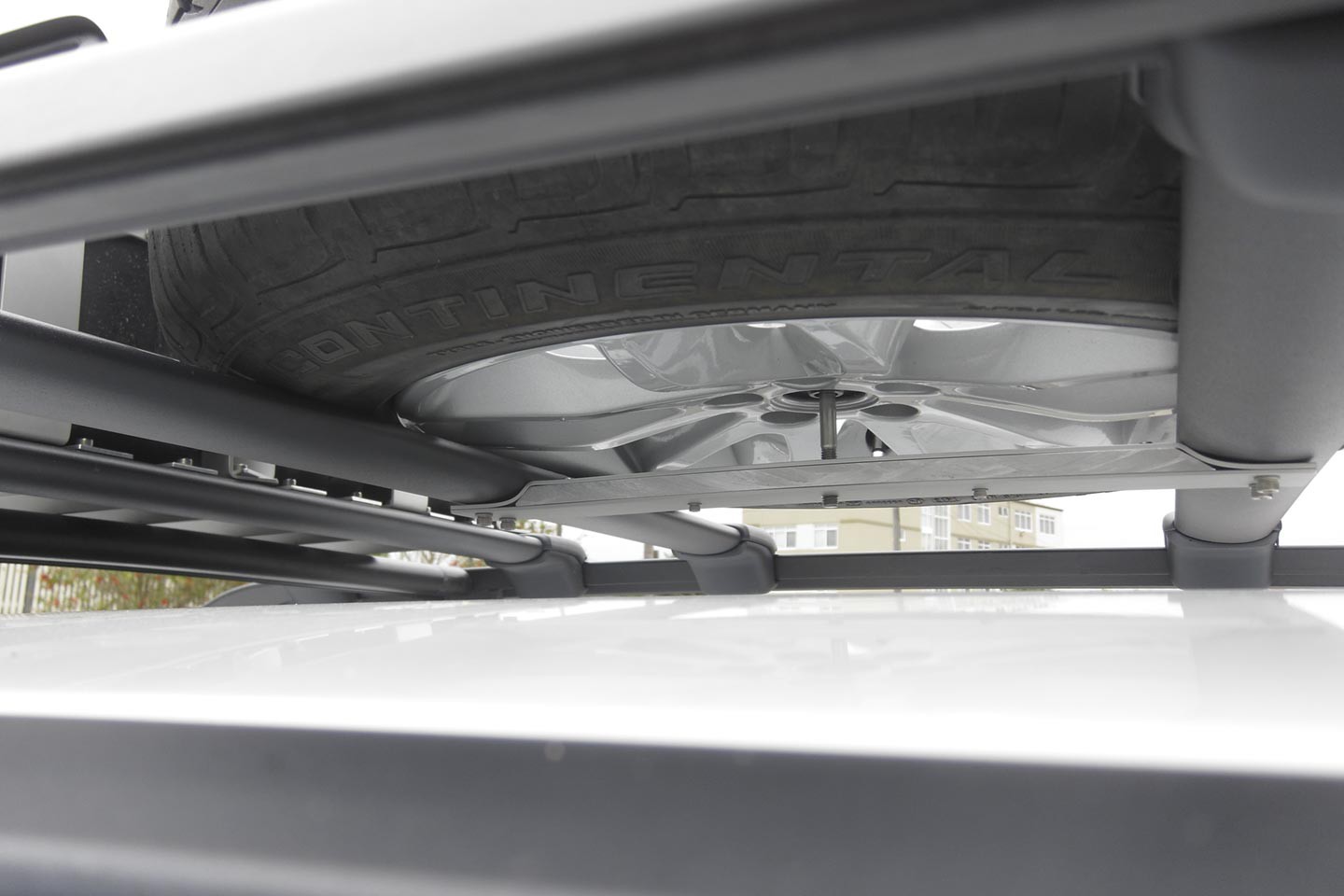
The aluminium bar is 5083 structural alloy drilled out to reduce weight.
I drew up an elevation drawing 1:1 scale of the entire roof setup to get spacing exactly right. Drawing up the setup solved a lot of issues & as a result saved a lot of money.
It's far cheaper to solve problems on a drawing. A pencil & sticky taping A4 paper together saves a lot of money.
Roof rack upgrades to spread loads due to stress cracking due to the poor design not suitable for corrugated roads.
Lots of M4 bolts tapped in everywhere.
Internal aluminium 5083 alloy also with grain lengthways for absolutely maximum strength (threaded end rod is simply for positioning aluminium bar then it is removed).
Filed by hand to fit exactly to size.
Teflon 1mm high density shims to stop squeaking & prolong integrity of joints.
Bracket for awning, 6 x M4 bolts for each of the two brackets, tapped & also Nyloc nuts.
Redesigned bolt to roof due to previous failures & to enable repairs in the outback with temporary M10 bolt.
The setup now is extremely solid. Nevertheless I still do carry spare hardware just in case.
After doing all these upgrades, I realise just what rubbish the original design was.
I forgot to mention, it the previous post, the bar to clamp down the spare wheel full of drilled holes is not simply screwed to the under side of the crossbars. There are blocks inside the crossbar extrusion. So in effect the extrusion wall is sandwiched with nylon shims to spread loads & allow movement.
I have tried to design everything with multiple & secondary fastening.
It has been work in progress over the years with a few key steps. But mainly keenly been aware of potential issues & fixing things the minute they have broken to prevent secondary damage.
A frighteningly large number of hours have gone into this, mainly to avoid having to fix things in the outback.
One has enough problems out there, but I don't want poor design to be one of them!
Weight was after assembly. A M6 Allen bolt which is lighter than a hex bolt plus a Nyloc nut is about 7.2 grams. M4 about 2.6 grams.
Nice work,is it much trouble bending bending the aluminum ?
No, it's only 3mm flat bar 6060 T5 & it's anodised so nicer for long term handling. The 3 x 20mm 316 stainless is a lot harder to bend. All the bends were done cold. There is not too much stress cracking. The hardest bit was estimating the amount of change in length for the previous side. But I got better at it the more bends I did.
Also, as I folded it up in a bench vice you need to think where to start so you don't end up not being able to fold because the vice is in the way. I made templates out of cardboard. This solved lots of issues, cheaper & easier to waste cardboard. Plan the folding hierarchy. You may need to stick some blocks out the side of the bench vice to fold over. Just need to be creative!
Since doing this job I have got a heat gun & folded aluminium. Set the aluminium up in a vice & have at hand ready to go a block of wood to force over the section of aluminium. Heat up the aluminium for about 30 to 60 seconds, then push over the aluminium with block of wood. It's still a similar effort as if it was cold but you will get next to no stress cracking.
Be extremely careful not to touch any of the aluminium as it is a brilliant heat sink or you will burn yourself. Have some multigrips etc to hold the aluminium to cool off the entire piece in water.
The aluminium will not really go any softer. If it does, it's only a touch & it will age harden over a week.
The two 10 x 50mm flat bar brackets for the solar panels, I got an engineering shop to fold them. You need a press to fold 10mm (unfortunately they are not anodised).
I tapped all the bolt holes, use tapping fluid, nothing more irritating than a broken tap in a hole.
Personally, I reckon I'll stick with my 4bee extra cab.
Yes there is a far bit of weight. You only realise once you weigh everything. Often we put the solar panels in the car & only have 50L of fuel if we are going remote. So under 100kg most of the time.
I suspect like mine the sand tracks are from Anaconda $99 for 2.
Yes, $99 a pair, at that price 4 gives me more options. Having said that I have never actually used them for their intended purpose, but we would not have gone to some places without the "insurance". As they are only cheap ones if they break or get stolen it's not the end of the world.
Apparently the sand tracks get a bit melted at the leading edge with tyre friction if one is not careful. I bought some dome hex screws to tap into the first couple of rows but haven't got around to it yet.
-- Edited by Whenarewethere on Friday 23rd of July 2021 03:14:20 PM
Out for a walk today doing our best to avoid the masses.
This is the second time I have seen particle board flooring fly off the front of the car. Luckily no one was decapitated.
Put a rope around the front of your load, & rear while at it.
Obviously warranty is not an issue, but insurance may be.
Land Rover crossbars 75, rails 100.
Thank you for your comments.
Hopefully people can use or adapt ideas for their own requirements.
Strengthing the roof rails properly has made all the difference with the integrity of the whole roof rack structure.
We are within our payload & are doing our best to keep weight off the roof. Want does one do in remote places!
If there are insurance issues we will buy a new Defender. Wifey wanted the previous one but I was over manual cars.