Hi, What is the general consensus on the minimum roof to solar panel clearance to allow for sufficient cooling airflow. regards Wayne.
Peter_n_Margaret said
10:08 AM Nov 10, 2019
I suggest 30mm minimum under the frame. More is better.
Cheers,
Peter
Colin Penrose said
10:22 AM Nov 10, 2019
II suggest to just get the standard plastic fittings and that will give you enough clearance. I think about $70 on EBay.I also made up these brackets with no holes going down into the roof.
I would suggest that the panel be set on an angle if possible to allow for convection.
T1 Terry said
06:55 PM Nov 10, 2019
Bagmaker wrote:
I would suggest that the panel be set on an angle if possible to allow for convection.
Great where it's possible, but because the vehicle is not always parked pointing nth, the angle can be more detrimental than the heat gain from flat mounting. Yrs ago Solarex recommended a minimum of 50mm clearance, if a wet back system wasn't so complex to implement, no clearance and free hot water would be the ultimate solar energy harvesting and keep the panels cooler than air circulation alone. Transferring the heat out of the panel cooling liquid and into the storage hot water without heating the panel cooling liquid while keeping it more energy efficient than simply tolerating the energy loss due to panel heat up is the tricky bit
T1 Terry
Dick0 said
07:26 PM Nov 10, 2019
Hi Wayne,
I have 3 x 200 watt panels on the caravan roof with a gap of 30mm.
That seems to be the average of most installations that I have seen on my travels.
Seems to work well for me and others.
As far as orientation of the panels...each his own.
My panels are flat over the roof...the 2 x 100ah AGM batteries are fully charged by noon or earlier.
AusQld said
07:11 AM Nov 11, 2019
Thank you peter..
AusQld said
07:13 AM Nov 11, 2019
Thanks for taking the time and the photo. Regards wayne
AusQld said
07:15 AM Nov 11, 2019
Good advice, not always possible, would help with keeping panel clean. Regards Wayne.
AusQld said
07:28 AM Nov 11, 2019
Thanks Terry, maybe a market for combination/integrated water heater, water cooled solar panel. In future will try to orient motor home to face longitudinally north. Regards Wayne.
AusQld said
07:29 AM Nov 11, 2019
Thanks Dicko.
Bagmaker said
11:24 AM Nov 12, 2019
For some chat,
if the panels WERE mounted on a slight angle, only a few mm clearance would suffice -especially if the lower side gap is slightly wider than the top.
In the same way that less clearance works better behind gas fridges compared to more -providing the convection route is possible.
It does amaze me that panels arent fitted with a coolant supply underneath, what a bonus that would provide!
T1 Terry said
01:50 PM Nov 13, 2019
The aluminium frame around a rigid panel is its worst enemy when it comes to trapping heat under the panel. The angle required to get that heat to flow away from the lip created at the top of the panel by the frame is quite significant. You will notice that the aluminium frame has reduced from the early days 50mm high down to 40mm and even 20mm for the smaller 60w panels. All to do with the heat trapped under the frame, not to make them lighter or cheaper to produce, that is just a by product.
T1 Terry
Jaahn said
03:36 PM Nov 13, 2019
Hi
Another thought about how much gap. If you want to get access to the fixing bolt nuts and/or the wiring to fit the panels and in the future remount them or do some work you will regret putting them on with a small gap. 50mm is probably the min to get a hand in or look. Next time I will make it 70 mm I think. Those plastic corner brackets are not enough for sure
Jaahn
Whenarewethere said
04:25 PM Nov 13, 2019
Another option, one could strengthen the bottom edge if necessary.
Clean up holes with a Sutton cross hole deburring tool.
Another thought about how much gap. If you want to get access to the fixing bolt nuts and/or the wiring to fit the panels and in the future remount them or do some work you will regret putting them on with a small gap. 50mm is probably the min to get a hand in or look. Next time I will make it 70 mm I think. Those plastic corner brackets are not enough for sure
Jaahn
Best to use rivet-nuts in the panel and stainless bolts through 70 x 25 x 1.6mm aluminium angle. Mount the aluminium to the panel/s, put it on the roof where you want the panel and mark out the footprint of the 25mm face onto the roof. Flip the panel over and out of the way, rough up the surface inside the marked area and rough up the aluminium angle face and clean all areas with metho and a rag. Apply a good bead of Selleys Armourflex on the aluminium angle leaving roughly a 5mm free space along each edge and a bit of criss-cross glue beading between the 2 beads of glue up each side. Flip the panel over so it sits in the marked out spots, apply a bit of pressure to squeeze out the glue a bit, a finger dipped in the full metho lid to smooth off the edges and add a bit more glue if needed. then 4 x 2ltr milk bottles filled with water up each side, a total of 16kg weight evenly spread, leave over night or for 24hrs is even better. Job done. You can remove the bolts and add a bit of glue up the inside edges of the aluminium if you think it needs it, but that Selleys Armourflex sets so well you will need to cut it off if you ever want to remove that piece of angle. We mount the aluminium angle so the 25mm bit is under the panel rather than facing out, just takes up less room and looks neater.
We generally line up the panels so the airflow under the panels is front to back. Not sure I'd get quite that carried away with the hole saw, but the idea has a lot of merit, just be real careful not the catch the edge of the panel itself, it will shatter at the slightest provocation.
T1 Terry
-- Edited by T1 Terry on Wednesday 13th of November 2019 05:47:39 PM
Jaahn said
06:37 PM Nov 15, 2019
Whenarewethere wrote:
Another option, one could strengthen the bottom edge if necessary.
Clean up holes with a Sutton cross hole deburring tool.
If I was to photo-shop some holes on my panel edges, then I would make them a bit larger say 2x and spaced out a bit more and as close to the top as possible. But using a real drill then possibly I would not bother. Which actually I have not
Jaahn
PS nice job by the way !!
-- Edited by Jaahn on Friday 15th of November 2019 06:41:41 PM
Whenarewethere said
08:16 PM Nov 15, 2019
You could drill 2 holes apart & use a Screw Hole Punch to enlarge, I think 12mm is the smallest diameter punch. They will cut through 1.6 mm aluminium nicely. A bit of cleaning up between the 2 holes..... Oval hole!
If you have a lot of holes in sheet they are great.
T1 Terry said
01:56 PM Nov 16, 2019
A scrap of thin steel (stainless sheet work well) laid on the inside back of the panel and the hole saw used from that direction, even to just make the pilot hole before drilling from the outside in using the next size smaller hole saw, would protect the glass panel from damage. Don't need a lot of holes, just enough to let the cooler air in and the heated air out. I still think the underside of the panel with a layer of that pool heater blanket stuff they stretch across the roof would be more effective and produce some energy saving as far as water heating at the same time.
T1 Terry
-- Edited by T1 Terry on Saturday 16th of November 2019 01:57:20 PM
terrydel said
09:23 PM Dec 17, 2019
T1 Terry wrote:
Jaahn wrote:
Hi
Another thought about how much gap. If you want to get access to the fixing bolt nuts and/or the wiring to fit the panels and in the future remount them or do some work you will regret putting them on with a small gap. 50mm is probably the min to get a hand in or look. Next time I will make it 70 mm I think. Those plastic corner brackets are not enough for sure
Jaahn
Best to use rivet-nuts in the panel and stainless bolts through 70 x 25 x 1.6mm aluminium angle. Mount the aluminium to the panel/s, put it on the roof where you want the panel and mark out the footprint of the 25mm face onto the roof. Flip the panel over and out of the way, rough up the surface inside the marked area and rough up the aluminium angle face and clean all areas with metho and a rag. Apply a good bead of Selleys Armourflex on the aluminium angle leaving roughly a 5mm free space along each edge and a bit of criss-cross glue beading between the 2 beads of glue up each side. Flip the panel over so it sits in the marked out spots, apply a bit of pressure to squeeze out the glue a bit, a finger dipped in the full metho lid to smooth off the edges and add a bit more glue if needed. then 4 x 2ltr milk bottles filled with water up each side, a total of 16kg weight evenly spread, leave over night or for 24hrs is even better. Job done. You can remove the bolts and add a bit of glue up the inside edges of the aluminium if you think it needs it, but that Selleys Armourflex sets so well you will need to cut it off if you ever want to remove that piece of angle. We mount the aluminium angle so the 25mm bit is under the panel rather than facing out, just takes up less room and looks neater.
We generally line up the panels so the airflow under the panels is front to back. Not sure I'd get quite that carried away with the hole saw, but the idea has a lot of merit, just be real careful not the catch the edge of the panel itself, it will shatter at the slightest provocation.
T1 Terry
-- Edited by T1 Terry on Wednesday 13th of November 2019 05:47:39 PM
Terry
Slightly off topic, would your procedure be suitable if I was to replace my existing panel with a larger one (250w), but placed across the van (east/west), that's as it's too big to go the traditional north/south placement. I'm wondering whether the travelling wind pressure would be problematic?
Many thanks
TerryD
Aus-Kiwi said
12:35 AM Dec 18, 2019
Slight angle , lower at front . I use 40x40 mm L alloy and screw and glue a wing off the side if a wire or branch hits ? The guide wing lifts any potential problem OVER the panel .. btw I run the solar wires down the roof fridge vent.
Iva Biggen said
09:56 AM Dec 18, 2019
AusQld wrote:
Hi, What is the general consensus on the minimum roof to solar panel clearance to allow for sufficient cooling airflow. regards Wayne.
No need to overthink the fitting of panels.
Those purpose brackets work fine and the use of a good Sikaflex product or similar will do the job and will give you the required clearance.
Cheers
Ivan
AusQld said
06:45 PM Jan 21, 2020
Hi fellow GNs
-- Edited by AusQld on Tuesday 21st of January 2020 07:14:00 PM
Di and Bill said
04:44 PM Feb 3, 2020
What size regulator do you run?
Jaahn said
07:51 PM Feb 3, 2020
Di and Bill wrote:
What size regulator do you run?
Hi Bill
A simple calculation.
For PWM reg look at the Max power current rating of all your panels and add them up for a max current. Then select a regulator that has a rated current larger than that.
If you are using a MPPT reg then you must use the Max power rating of all the panels to see the reg power rating needed.
Jaahn
Phillipn said
12:02 AM Feb 4, 2020
Jaahn wrote:
Di and Bill wrote:
What size regulator do you run?
Hi Bill
A simple calculation.
For PWM reg look at the Max power current rating of all your panels and add them up for a max current. Then select a regulator that has a rated current larger than that.
If you are using a MPPT reg then you must use the Max power rating of all the panels to see the reg power rating needed.
Jaahn
Add the total number of watts of the solar panels divide by 12 [ on a 12v system] and the amp rating of the regulator should be more or equal to the answer.
Eg. 300 watts of solar/ 12 = 25 amps. A 25 amp regulator or larger is required.
That information came from a supplier of solar panels when I purchased my solar panels.
Hi, What is the general consensus on the minimum roof to solar panel clearance to allow for sufficient cooling airflow.
regards Wayne.
Cheers,
Peter
II suggest to just get the standard plastic fittings and that will give you enough clearance. I think about $70 on EBay.I also made up these brackets with no holes going down into the roof.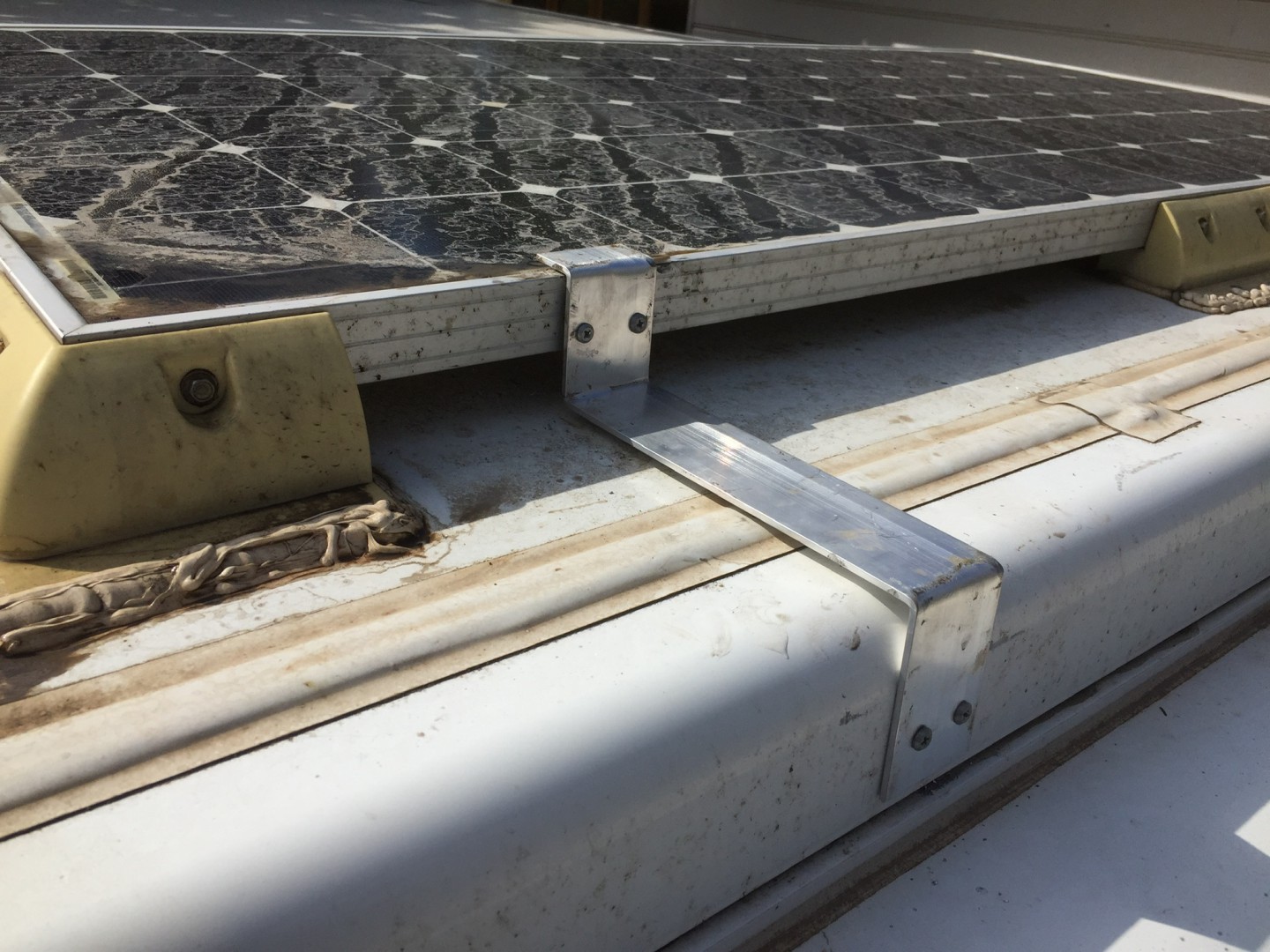
Great where it's possible, but because the vehicle is not always parked pointing nth, the angle can be more detrimental than the heat gain from flat mounting. Yrs ago Solarex recommended a minimum of 50mm clearance, if a wet back system wasn't so complex to implement, no clearance and free hot water would be the ultimate solar energy harvesting and keep the panels cooler than air circulation alone. Transferring the heat out of the panel cooling liquid and into the storage hot water without heating the panel cooling liquid while keeping it more energy efficient than simply tolerating the energy loss due to panel heat up is the tricky bit
T1 Terry
Hi Wayne,
I have 3 x 200 watt panels on the caravan roof with a gap of 30mm.
That seems to be the average of most installations that I have seen on my travels.
Seems to work well for me and others.
As far as orientation of the panels...each his own.
My panels are flat over the roof...the 2 x 100ah AGM batteries are fully charged by noon or earlier.
Thank you peter..
Thanks for taking the time and the photo. Regards wayne
Good advice, not always possible, would help with keeping panel clean. Regards Wayne.
Thanks Terry, maybe a market for combination/integrated water heater, water cooled solar panel. In future will try to orient motor home to face longitudinally north. Regards Wayne.
Thanks Dicko.
if the panels WERE mounted on a slight angle, only a few mm clearance would suffice -especially if the lower side gap is slightly wider than the top.
In the same way that less clearance works better behind gas fridges compared to more -providing the convection route is possible.
It does amaze me that panels arent fitted with a coolant supply underneath, what a bonus that would provide!
T1 Terry
Hi
Another thought about how much gap. If you want to get access to the fixing bolt nuts and/or the wiring to fit the panels and in the future remount them or do some work you will regret putting them on with a small gap. 50mm is probably the min to get a hand in or look. Next time I will make it 70 mm I think. Those plastic corner brackets are not enough for sure
Jaahn
Another option, one could strengthen the bottom edge if necessary.
Clean up holes with a Sutton cross hole deburring tool.
Best to use rivet-nuts in the panel and stainless bolts through 70 x 25 x 1.6mm aluminium angle. Mount the aluminium to the panel/s, put it on the roof where you want the panel and mark out the footprint of the 25mm face onto the roof. Flip the panel over and out of the way, rough up the surface inside the marked area and rough up the aluminium angle face and clean all areas with metho and a rag. Apply a good bead of Selleys Armourflex on the aluminium angle leaving roughly a 5mm free space along each edge and a bit of criss-cross glue beading between the 2 beads of glue up each side. Flip the panel over so it sits in the marked out spots, apply a bit of pressure to squeeze out the glue a bit, a finger dipped in the full metho lid to smooth off the edges and add a bit more glue if needed. then 4 x 2ltr milk bottles filled with water up each side, a total of 16kg weight evenly spread, leave over night or for 24hrs is even better. Job done. You can remove the bolts and add a bit of glue up the inside edges of the aluminium if you think it needs it, but that Selleys Armourflex sets so well you will need to cut it off if you ever want to remove that piece of angle. We mount the aluminium angle so the 25mm bit is under the panel rather than facing out, just takes up less room and looks neater.
We generally line up the panels so the airflow under the panels is front to back. Not sure I'd get quite that carried away with the hole saw, but the idea has a lot of merit, just be real careful not the catch the edge of the panel itself, it will shatter at the slightest provocation.
T1 Terry
-- Edited by T1 Terry on Wednesday 13th of November 2019 05:47:39 PM
-- Edited by Jaahn on Friday 15th of November 2019 06:41:41 PM
You could drill 2 holes apart & use a Screw Hole Punch to enlarge, I think 12mm is the smallest diameter punch. They will cut through 1.6 mm aluminium nicely. A bit of cleaning up between the 2 holes..... Oval hole!
If you have a lot of holes in sheet they are great.
A scrap of thin steel (stainless sheet work well) laid on the inside back of the panel and the hole saw used from that direction, even to just make the pilot hole before drilling from the outside in using the next size smaller hole saw, would protect the glass panel from damage. Don't need a lot of holes, just enough to let the cooler air in and the heated air out.
I still think the underside of the panel with a layer of that pool heater blanket stuff they stretch across the roof would be more effective and produce some energy saving as far as water heating at the same time.
T1 Terry
-- Edited by T1 Terry on Saturday 16th of November 2019 01:57:20 PM
Terry
Slightly off topic, would your procedure be suitable if I was to replace my existing panel with a larger one (250w), but placed across the van (east/west), that's as it's too big to go the traditional north/south placement. I'm wondering whether the travelling wind pressure would be problematic?
Many thanks
TerryD
No need to overthink the fitting of panels.
Those purpose brackets work fine and the use of a good Sikaflex product or similar will do the job and will give you the required clearance.
Cheers
Ivan
Hi fellow GNs
-- Edited by AusQld on Tuesday 21st of January 2020 07:14:00 PM
What size regulator do you run?
Hi Bill
A simple calculation.
For PWM reg look at the Max power current rating of all your panels and add them up for a max current. Then select a regulator that has a rated current larger than that.
If you are using a MPPT reg then you must use the Max power rating of all the panels to see the reg power rating needed.
Jaahn
Add the total number of watts of the solar panels divide by 12 [ on a 12v system] and the amp rating of the regulator should be more or equal to the answer.
Eg. 300 watts of solar/ 12 = 25 amps. A 25 amp regulator or larger is required.
That information came from a supplier of solar panels when I purchased my solar panels.