Hi all has anyone tried a wind spoiler on the rear roof of their 4WD to deflect the wind and reduce fuel consuption whilst towing a full size van?
dogbox said
01:09 PM May 1, 2019
unless you are doing big kilometres at high speed the cost outweighs the benifits
Olive Oil said
01:19 PM May 1, 2019
We threw my late fathers one down the tip a while back.
It had a map of Australia on it & he'd painted on it where he'd been in his retirement.
They were all the go back in the 70's & 80's.
He always thought of himself as an aspiring truck driver even though his caravan was only 11ft 6ins long.
dabbler said
01:49 PM May 1, 2019
The gap between tow vehicle and van is probably too great to achieve a deflection. Creating turbulence can increase efficiency but it's very specific to speed and geometry of setup.
Bobdown said
03:14 PM May 1, 2019
I have one, they definitely work with air flow, not sure about fuel saving.
Every semi- trailer has a spoiler on top, bar none.
The best benefit I have found is that you do not get that big rush of air, from passing double and triple road trains.
Before it felt like it would blow you backwards, now there is nothing at all, doing 100 kph.
Some benefits, more stable on the road, is it worth $250.....I dunno?
Also adding a blade off the back of the caravan, side & top edges will help, or drive slower.
travelyounger said
03:54 PM May 1, 2019
I have a tinny in my ute it breaks the wind around my van I get better fuel economy it stops branches and bird droppings on my car keeps it cooler and at the end of the day I can go fishing
rockylizard said
04:03 PM May 1, 2019
Gday...
Aerofoils on the roof of cars to assist towing. The theory has been around for decades - and was particularly popular in the 1960s and 1970s.
It seems to have fallen out of favour in recent times. However, Bob's testimonial on his experience with the one he has on his vehicle gives pause for thought.
The video is compelling and leans quite heavily on the 'science' of it all - including the effect (improvements?) on all heavy haulage vehicles - and demonstrates how airflow can be modified for improved airflow with the aerofoil.
However, if one looks at the 'example vehicles' shown toward the end of the video it begs a few questions.
Each of those vehicles has a very different distance from the tip of the aerofoil and the front of the caravan - suggesting that the positioning of the aerofoil would be critical to the effectiveness and efficiency of the aerofoil. How does one determine the 'critical position' for the aerofoil - without the expense and inconvenience of a full size wind tunnel.
These distances are not a usual problem for heavy haulage vehicles as the distance from prime mover to front trailer is fairly constant from vehicle to vehicle.
All the above just food for though.
Hopefully, there will be those who have used, or do use, aerofoils who may find this thread and provide comment on their experiences.
Cheers - John
Jaahn said
04:06 PM May 1, 2019
travelyounger wrote:
I have a tinny in my ute it breaks the wind around my van I get better fuel economy it stops branches and bird droppings on my car keeps it cooler and at the end of the day I can go fishing
Hi
I am not sure about the "breaking wind" around my van, but sounds like a win, win, win, win, win. Looks like common sense to me. But seeing as it did not cost a bomb, hard to market to cashed up GNs.
Jaahn
delapan said
07:23 PM May 1, 2019
Hi Doogie51, yep have just fitted a spoiler Stealthwing have been chasing one for few years after my old one of dubious pedigree died My observations on the trip so far, has made the whole rig VERY stable, very little wind resistance, improved economy, dont know yet, but very noticable stability improvements.
to Rocky Lizard, in those 3 pictures, 2 of the vehicles have them fitted too far forward, over the rear wheel is the best spot apparently, www.stealthwing.com is the website, i have no affiliation with them but have just answered a question that was asked, regards
-- Edited by delapan on Wednesday 1st of May 2019 07:25:23 PM
erad said
07:48 PM May 1, 2019
I tow a 16.5 ft Jayco poptop caravan with my NW Pajero (2013 model). When we ordered the van, I asked for the drawbar to be 150 mm shorter. They made it 200 mm shorter than standard instead. This has two major effects:
1 The download on the towball is heavier than standard. The whole rig is very stable, but it does load the rear suspension of my tug quite a bit.
2 The aerodynamics are interesting. The van is about 250 mm higher than the Pajero when in travelling mode. I certainly don't need a deflector. More interesting - on a wet road, there is NO spray gets on the rear window of the Pajero unless I am stopped at traffic lights. Travelling at 100 km/h, the whole rear end of the car stays clean. I can only conclude that the airflow is deflected over the van instead of generating a roller between the van and the tug. There must be some airflow in the gap, because if I have been on a dusty road and have a load of dust on the rear bumper, that dust is completely gone as soon as I get up to about 80 km/h. I get excellent fuel consumption - about 11.3 L/100 km @ 100 km/h GPS speed on level ground with no headwind. Downhill eg Canberra to Sydney, I get even better than that - in the high 9's. If I flog it at 110 km/h in hilly country, I get high 13's and in the worst case, over 15L/100 km, but I rarely do that.
I believe that I could improve the consumption even more if I were to mount foils on the rear of the van which would 'fill' the low pressure area behind the van when travelling at speed, but at this stage, I am not going that far.
Eaglemax said
11:44 PM May 1, 2019
They needed defectors in the 70's due to the flat front profile of caravans then.
SouthernComfort said
09:10 AM May 2, 2019
Majority of vans were towed with sedans and wagons in the 60's & 70's, lower roof line, deflectors attempted to raise the airflow. Not sure how successfully. SUV's may compensate slightly, who knows?? Probably no good on a ute, roof mounting too far forward.
Whenarewethere said
09:35 AM May 2, 2019
Car manufacturers have moved away from wind tunnel testing. Software testing is more accurate as you can have the road moving.
AutoCAD have software, but unless you have experience in 3d it is a very steep learning curve. I've been doing 3d for decades & it changes quicker than one can learn. Both good & bad!
The ideal would be, you take photos of your rig from various angles & the 3d software converts 2d to 3d & gives you a air flow diagram for a few different speeds.
Business opportunity if someone wants to put the effort in, I'll happy with 1% royalties!
jontee said
11:04 AM May 2, 2019
G`day Doogie 51 ,
I bought an Aeroplus unit late last year after speaking to several people who were using them .
They all claimed the same benefits as Bobdown has expressed , however , a couple claimed to have about a 10 % improvement in fuel consumption .My experience has been the same as Bobdown `s . I have done the same trip from ACT to Camden and return several times now with and without the aerofoil fitted and have experienced an improvement of 5 % to 7% in fuel consumption . I know conditions vary each trip and are never the same . The main benefit is the stability of the rig and the fact that there are no insects and crap on the
front of the van . My tug is dual cab with canopy and the van is a full van .
Just my experience using an aerofoil and consistent with others that use one .
Cheers ,
Jontee
Phillipn said
11:40 AM May 2, 2019
This wind deflector was made by a fellow who said it made an improvement in his fuel economy.
phum said
08:57 AM May 3, 2019
What are the blades fitted to the back of the van spoken of earlier
Phillipn said
09:18 AM May 3, 2019
Whenarewethere wrote:
Also adding a blade off the back of the caravan, side & top edges will help, or drive slower.
A photo please.
diggerop said
06:27 PM May 3, 2019
Vortex generators would be what is being referred too as blades.
I made some like this for my van. They do make a improvement to fuel but a bit like the airfoil it's not much but definitely made an improvement.
Dimensions please
Doogie51 said
10:09 AM May 4, 2019
Thanks fellow Nomadders, all very interesting, will go for our first trip in our starcraft outback soon and check the fuel economy compared to our old 18' freedom poptop.
diggerop said
07:21 PM May 4, 2019
I made up my own dimensions and copied the angles as best I could. Mine would be about 3" wide.
phum said
07:16 AM May 6, 2019
diggerop wrote:
I made up my own dimensions and copied the angles as best I could. Mine would be about 3" wide.
A few more dimensions, approx will do would be helpfull.
We threw my late fathers one down the tip a while back.

It had a map of Australia on it & he'd painted on it where he'd been in his retirement.
They were all the go back in the 70's & 80's.
He always thought of himself as an aspiring truck driver even though his caravan was only 11ft 6ins long.
I have one, they definitely work with air flow, not sure about fuel saving.
Every semi- trailer has a spoiler on top, bar none.
The best benefit I have found is that you do not get that big rush of air, from passing double and triple road trains.
Before it felt like it would blow you backwards, now there is nothing at all, doing 100 kph.
Some benefits, more stable on the road, is it worth $250.....I dunno?
Cheers Bob
https://www.youtube.com/watch?v=QmwkrQbTgNQ
Also adding a blade off the back of the caravan, side & top edges will help, or drive slower.
Gday...
Aerofoils on the roof of cars to assist towing. The theory has been around for decades - and was particularly popular in the 1960s and 1970s.
It seems to have fallen out of favour in recent times. However, Bob's testimonial on his experience with the one he has on his vehicle gives pause for thought.
The video is compelling and leans quite heavily on the 'science' of it all - including the effect (improvements?) on all heavy haulage vehicles - and demonstrates how airflow can be modified for improved airflow with the aerofoil.
However, if one looks at the 'example vehicles' shown toward the end of the video it begs a few questions.
Each of those vehicles has a very different distance from the tip of the aerofoil and the front of the caravan - suggesting that the positioning of the aerofoil would be critical to the effectiveness and efficiency of the aerofoil. How does one determine the 'critical position' for the aerofoil - without the expense and inconvenience of a full size wind tunnel.
These distances are not a usual problem for heavy haulage vehicles as the distance from prime mover to front trailer is fairly constant from vehicle to vehicle.
All the above just food for though.
Hopefully, there will be those who have used, or do use, aerofoils who may find this thread and provide comment on their experiences.
Cheers - John
Hi
I am not sure about the "breaking wind" around my van, but sounds like a win, win, win, win, win. Looks like common sense to me. But seeing as it did not cost a bomb, hard to market to cashed up GNs.
Jaahn
Hi Doogie51, yep have just fitted a spoiler Stealthwing have been chasing one for few years after my old one of dubious pedigree died My observations on the trip so far, has made the whole rig VERY stable, very little wind resistance, improved economy, dont know yet, but very noticable stability improvements.
to Rocky Lizard, in those 3 pictures, 2 of the vehicles have them fitted too far forward, over the rear wheel is the best spot apparently, www.stealthwing.com is the website, i have no affiliation with them but have just answered a question that was asked, regards
-- Edited by delapan on Wednesday 1st of May 2019 07:25:23 PM
I tow a 16.5 ft Jayco poptop caravan with my NW Pajero (2013 model). When we ordered the van, I asked for the drawbar to be 150 mm shorter. They made it 200 mm shorter than standard instead. This has two major effects:
1 The download on the towball is heavier than standard. The whole rig is very stable, but it does load the rear suspension of my tug quite a bit.
2 The aerodynamics are interesting. The van is about 250 mm higher than the Pajero when in travelling mode. I certainly don't need a deflector. More interesting - on a wet road, there is NO spray gets on the rear window of the Pajero unless I am stopped at traffic lights. Travelling at 100 km/h, the whole rear end of the car stays clean. I can only conclude that the airflow is deflected over the van instead of generating a roller between the van and the tug. There must be some airflow in the gap, because if I have been on a dusty road and have a load of dust on the rear bumper, that dust is completely gone as soon as I get up to about 80 km/h. I get excellent fuel consumption - about 11.3 L/100 km @ 100 km/h GPS speed on level ground with no headwind. Downhill eg Canberra to Sydney, I get even better than that - in the high 9's. If I flog it at 110 km/h in hilly country, I get high 13's and in the worst case, over 15L/100 km, but I rarely do that.
I believe that I could improve the consumption even more if I were to mount foils on the rear of the van which would 'fill' the low pressure area behind the van when travelling at speed, but at this stage, I am not going that far.
Car manufacturers have moved away from wind tunnel testing. Software testing is more accurate as you can have the road moving.
AutoCAD have software, but unless you have experience in 3d it is a very steep learning curve. I've been doing 3d for decades & it changes quicker than one can learn. Both good & bad!
The ideal would be, you take photos of your rig from various angles & the 3d software converts 2d to 3d & gives you a air flow diagram for a few different speeds.
Business opportunity if someone wants to put the effort in, I'll happy with 1% royalties!
I bought an Aeroplus unit late last year after speaking to several people who were using them .
They all claimed the same benefits as Bobdown has expressed , however , a couple claimed to have about a 10 % improvement in fuel consumption .My experience has been the same as Bobdown `s . I have done the same trip from ACT to Camden and return several times now with and without the aerofoil fitted and have experienced an improvement of 5 % to 7% in fuel consumption . I know conditions vary each trip and are never the same . The main benefit is the stability of the rig and the fact that there are no insects and crap on the
front of the van . My tug is dual cab with canopy and the van is a full van .
Just my experience using an aerofoil and consistent with others that use one .
Cheers ,
Jontee
This wind deflector was made by a fellow who said it made an improvement in his fuel economy.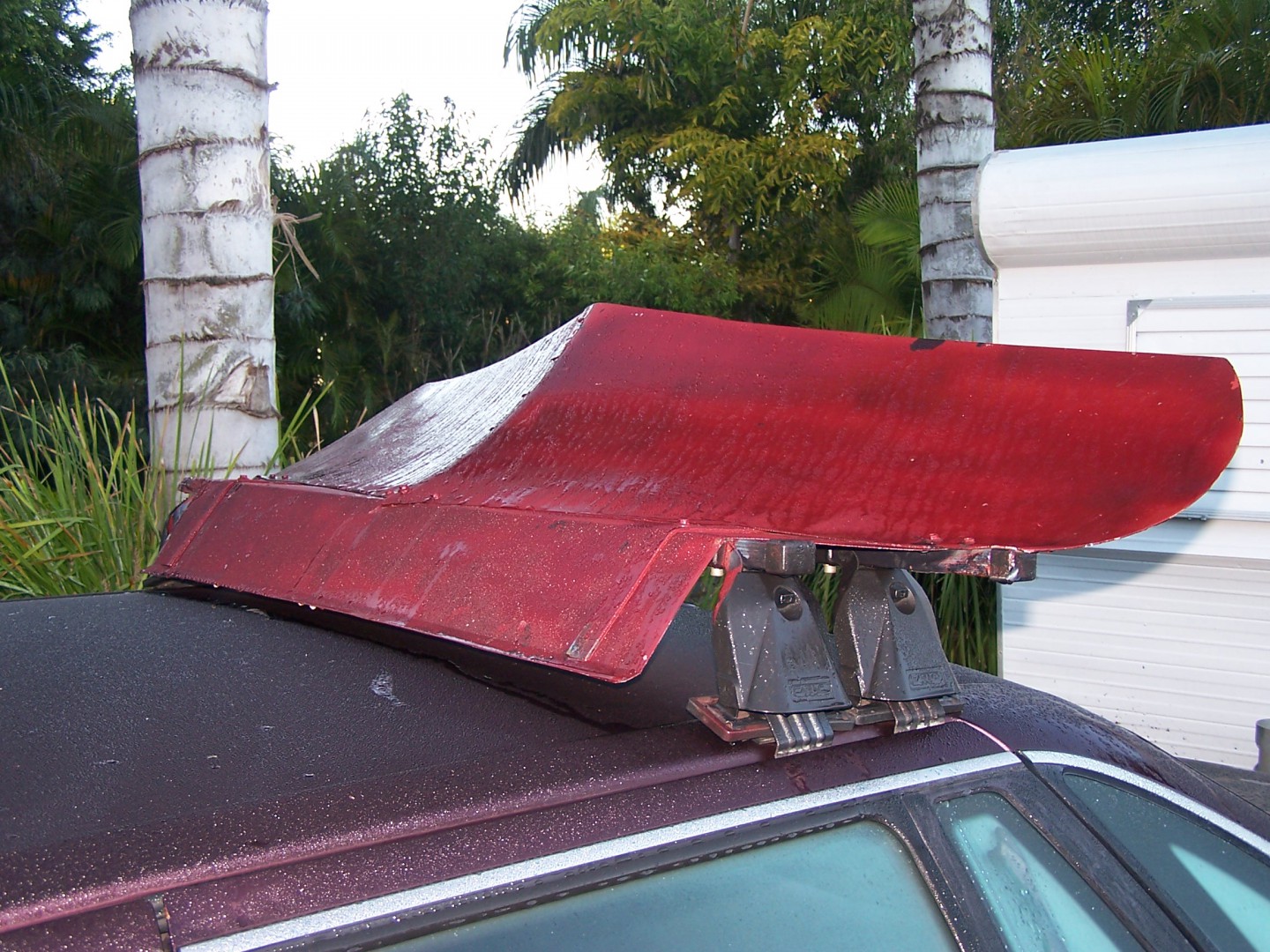
A photo please.
Vortex generators would be what is being referred too as blades.
vortex generators
I made some like this for my van. They do make a improvement to fuel but a bit like the airfoil it's not much but definitely made an improvement.
Dimensions please
A few more dimensions, approx will do would be helpfull.
This is what I made mine .