A technical question from a layman, which hopefully may help others in the future
Can someone give me a link to blocking diodes, for a 160 watt lightweight portable solar panel
I am thinking of either connecting directly to the leisure/house batteries, through the portable solar panel regulator At times when the roof solar is under tree shade, and disconnected In this scenario, I believe that I will not require blocking diodes
Or alternatively disconnecting the portable solar panel regulator wires Then going direct from the portable solar panel, to the leisure/house batteries DC/DC charger solar regulator In parallel with the roof solar panel, at times of an overcast sky
I will not be attempting to run both solar regulators at the same time
The roof panel is the same open circuit voltage, as the portable solar panel, but 300 watts
This portable solar panel, does not say that it should not be connected in series or parallel
I notice that the Maximum System Voltage is 800, does this mean that I do not require blocking diodes
Any input will be appreciated
The specifications of the portable solar panel are in the picture below
T1 Terry said
01:39 PM Sep 28, 2018
Drop us a PM with an address and how many you need and we'll mail them out if you like. We had to buy a min quantity in the hundreds and I doubt we'll ever use them all.
T1 Terry
Tony Bev said
03:29 PM Sep 28, 2018
Hi Terry
I have sent you a PM, and thank you
dabbler said
04:50 PM Sep 28, 2018
Nice one T1 Terry.
Jaahn said
05:02 PM Sep 28, 2018
dabbler wrote:
Nice one T1 Terry.
+1 Terry
Jaahn
Warren-Pat_01 said
11:34 PM Sep 30, 2018
Hi Tony,
I'd suggest the 800v is the maximum voltage (& has adequate isolation resistance to ensure safe operation) that you could connect a large number of these panels in series for a house system - something not to meddle with!
Gee the panels are light in weight! The ones that were on my roof before our roof fire are 185w & weigh 14Kg!
Connecting them in parallel is possibly the best - unless you have a MTTP controller. You've got 18.6v giving 8.6A - how much power do you require?
Tony Bev said
02:03 AM Oct 1, 2018
Warren-Pat_01 wrote:
Hi Tony, I'd suggest the 800v is the maximum voltage (& has adequate isolation resistance to ensure safe operation) that you could connect a large number of these panels in series for a house system - something not to meddle with!
Gee the panels are light in weight! The ones that were on my roof before our roof fire are 185w & weigh 14Kg!
Connecting them in parallel is possibly the best - unless you have a MTTP controller. You've got 18.6v giving 8.6A - how much power do you require?
Hi Warren
You ask how much power do I need
I have a 12 volt fridge, using at the worst scenario, about 60 amp hours each day Plus TV/lights/fans, using at the worst scenario, about 60 amp hours each day
In a worst case scenario, I would like to have 120 amp hour of solar each day This is half of my battery capacity of 240 Amp Hours
I have 300 watts on the roof of my motorhome giving, 14 amps bulk charge, in ideal conditions When it is overcast for a few days, or if I can not orientate the roof solar to face north, I have to switch the TV off to save the batteries
This extra portable solar panel, (I picked it for its lightness), will be used when the roof solar is not in ideal conditions
Travelling solo, the roof panel is adequate for my needs Travelling with my wife, the TV is a luxury she prefers to have I am led to believe, that you can never have too much solar power on tap
The reason for the blocking diodes, is that I have read, that some lightweight panels, are not to be joined either series or parallel
My theory, (I am not an Electrician), is that at times when the roof air-conditioner, is partly shading the roof solar panel, the two panels will not be the exact same voltage I have seen from just under 17 volts, to just over 19 volts, from the roof solar panel, to the inlet of the DC/DC charger/solar controller regulator
My second theory is that the portable solar panel, by manual tracking to the sun, will at times be producing, either lower or higher voltage, than the roof solar panel
In hindsight, I should have perhaps put more (match sets), of solar panels on the roof Unfortunately with the air conditioner, and hatches, one panel would have always been partly shaded, unless I was prepared to keep moving the vehicle throughout the day
I am learning by trial and error, while I had the gas fridge, my 300 watts of solar on the roof, was more than adequate
DeBe said
01:00 PM Oct 1, 2018
While we are on the subject of Diodes, have a question for Terry. These are pictures of the conection box on the back of one of my 160W folding solar panels. Just wondering what the purpose of these diodes are as they are across the output of the panels?
These are bypass diodes, although the soldering is so bad I doubt they work at all. It looks like the ribbon from the panel connecting to the positive in the second photo is actually broken away so possibly half that panel (if the diodes are making contact) or all that panel (if the diodes are not making a good contact) isn't working at all. The diode is like a one way valve, the silver stripe end is the stopper end, so electrons can flow from the non stripped end to the striped end but not back the other way ..... think I've got that right, electron flow is the reverse to what was thought to be the original direction of flow and as this is a current producing device the flow direction must be viewed with this in mind ...... I think I need another coffee.
The intention here is if half the panel is shaded and not producing current, it can bypass flowing through that section of the panel and continue on to the next section. mostly used where panels are connected in series so current isn't forced through a panel that isn't producing anything that would increase the voltage on the output side above the voltage on the input side. An easier passage to by pass that section of the panel.
A bit more techo stuff if ya haven't passed out yet. If the panel is producing voltage then the voltage would be higher on the striped end than the non striped end, so the one way valve is blocking the flow, held shut by the higher voltage on the striped end compared to the non striped end. This works the same with a blocking diode, it's just wired in differently.
To work as a blocking diode, the positive from the panel goes into the non striped end. On the striped end connect the positive going off to the junction box in a parallel connected system or on to the negative of the next panel in a series connected system. The thing works the same way, if the panel is producing the voltage will push past the one way valve because it has enough voltage pressure and enough force from the current (amps) to push it through. A bit is lost as heat so the idea is to use a diode twice the capacity of the expected flow so the restriction is minimised and special diodes called Schottky diodes that have half the resistance of normal diodes and also generally used for this job.
If the cell isn't producing enough volts at enough amps to push the one way valve open against the voltage the other side trying to hold it closed, nothing comes out, but also nothing flows back in either. This is important when using solar panels with a lower ability to resist backflow because if the current can flow back into the panel it will turn into a heating element rather than a current producer. If you scroll down on this page from solar4rv you can see the panels cells actually becoming heaters https://www.solar4rvs.com.au/buying/buyer-guides/choosing-flexible-solar-panels/how-to-compare-good-and-bad-flexible-solar-panels/
The thing this clearly shows in this article is their panels do not have blocking diodes, or that test could not be used as the cell heating would never occur.
The causes for the panel with the bit melted out the centre is most likely series connected creating a high voltage and possibly directly mounted to an aluminium roof or a sheet of aluminium intended to be a heat sink. Heat and possibly friction from movement breaks down the insulation. The dead short between the high voltage at what ever current the system was producing to the zero voltage contact with some form of metal connected to the RV's earth system (that is also connected to the battery negative via the chassis earth strap) would have been just like the old fashioned bar radiator producing lots of heat.
T1 Terry
DeBe said
04:46 PM Oct 1, 2018
Thanks for that info Terry, interesting read on what to look for in cell construction. The pictures of the conections are on an un branded folding 160W panel, it does put out 9amps on short circuit But opencircuit voltage is only 15V on a hot day, it was a cheap panel. Looks like some soldering is required. I did buy some Gista branded 160W folding solar panels, they do put out 21V open circuit & 9A short circuit, but the soldering was worse, had to re solder all the conections.
T1 Terry said
06:07 PM Oct 1, 2018
Look around the local auto parts store for forked spade terminal in smaller packs than these at Jay Car www.jaycar.com.au/forked-spade-blue-pk-100/p/PT4624 PT4724 are the yellow bigger ones that will take 6mm auto cable. Remove the plastic collar on the grinder/sander disc and cut the copper collar up the centre through where the actual terminal is split under neither it. Now you can crimp the wires on properly and solder as well if you want, then they slip under the screw and make a neat wire connection that can be removed easily if needed. You might need to find a bit longer screw as well, they are miserable on what the use in these cheapie panels, but they still work ok after you do a bit of fixing up.
T1 Terry
Bagmaker said
08:35 AM Oct 2, 2018
blocking diode installed not particularly neat but pretty simple
Also once again thanks to T1 Terry, who has told me that the diodes are on the way
I very recently found on the internet, concerning blocking diodes, that when the panels are in PARALLEL, they go onto the positive wire
Below is a snip, from the attachment, Ian had put up Hopefully, it may help others in the future
Warren-Pat_01 said
11:14 PM Oct 7, 2018
Gee Ian,
That handbook is very comprehensive!
Perhaps if the "Fly-by-Nighter" (thank you Mr Rudd) crowd who installed my grid house panels had this handbook, my house might not have caught fire!
Jaahn said
09:53 PM Oct 8, 2018
Hi
Thanks for that reference Ian, well set out diagrams of the recommended way to install the panels.
Here is another reference that explains the diodes too. It may be easier to understand the diode use because of the different way they have drawn the connections. The same thing but different
Never too old to brush up on these things. Or perhaps that is why I have to brush up on it
Jaahn
Bypass Diodes in Photovoltaic Arrays
-- Edited by Jaahn on Monday 8th of October 2018 09:55:18 PM
-- Edited by Jaahn on Monday 8th of October 2018 10:27:49 PM
T1 Terry said
11:36 AM Oct 9, 2018
I wish I'd had the link to that excellent site when they were tearing pieces off me on a number of other forum, some were by uni professors who have a side business of installing lithium battery and solar to off grid houses. they refuted the need for blocking diodes and virtually said I didn't have a clue what I was talking about
T1 Terry
-- Edited by T1 Terry on Tuesday 9th of October 2018 12:25:50 PM
DeBe said
07:33 PM Oct 11, 2018
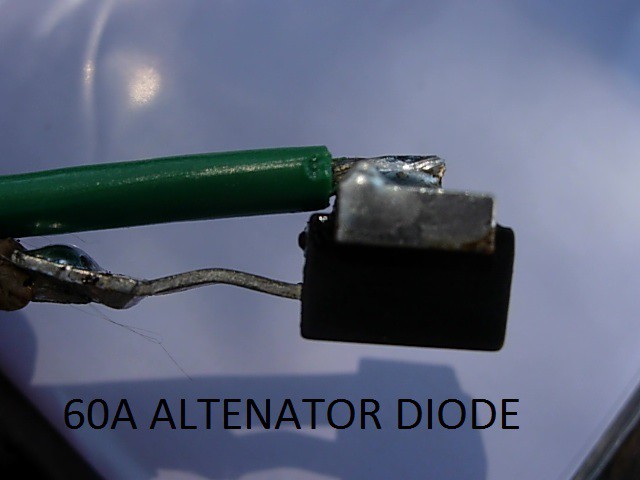
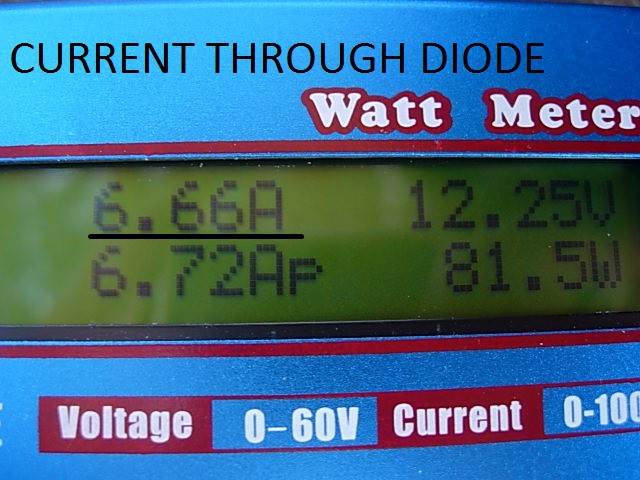
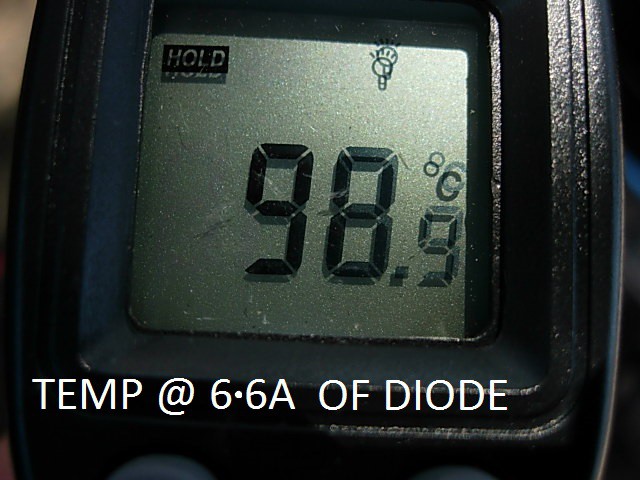
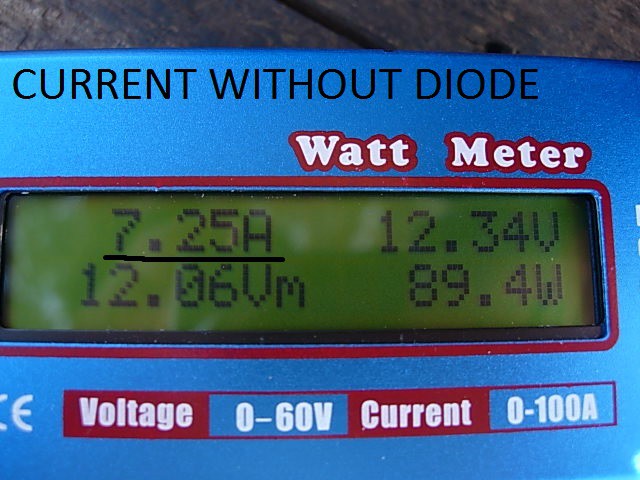
I personaly would not be keen on putting a Blocking Diode inside the conector box on the back of a Solar panel. Particularly on 160W & above, I thaught I would do a bit of a test on how hot a Diode gets when passing around 6-7Amps. Quite surprizing I stopped the test when the Diode reached 98 Deg C. They should be mounted in free air or on a heat sink. The diode used was out of a 60 Amp altenator. There was a loss of .8V across the diode & .59Amps. The test was using a 160W panel.
DeBe I am working with 160w panels and diode heat is one of the problems. From what I have been advised by persons on this forum, I need to use Schottky diodes, these have a reduced voltage drop and produce less heat. Trouble is for 160w panels the diodes need to be about 16amps, most solar stockests only carry 6 amp, as I was told this afternoon, just twist 3, 6 amp diodes together, what a mess that would be. However I have 16 amp diodes on the way.
I never thought that having more than one panel would present so many unforseen problems.
Maybe someone on here could advise how these diodes should be mounted, enclosure, space, material etc.
DeBe said
10:37 PM Oct 11, 2018
I have tried 600V 16Amp Shottkey diodes (Salvaged for free from scraped Solar Grid Tie Inverters) they also get quite hot with out heatsinks when passing 8 Amps.
DeBe I am working with 160w panels and diode heat is one of the problems. From what I have been advised by persons on this forum, I need to use Schottky diodes, these have a reduced voltage drop and produce less heat. Trouble is for 160w panels the diodes need to be about 16amps, most solar stockests only carry 6 amp, as I was told this afternoon, just twist 3, 6 amp diodes together, what a mess that would be. However I have 16 amp diodes on the way. I never thought that having more than one panel would present so many unforseen problems. Maybe someone on here could advise how these diodes should be mounted, enclosure, space, material etc.
Hi Ian
I am still working on my system, as other things had cropped up
T1 Terry had sent me four 15 amp diodes, I have used two of them, and you are welcome to the other two, free of charge, (you must thank T1 Terry) Just PM me a place to send them
I have no idea, about needing 16 amp, for a 160 watt solar panel The specs of my 160 watt panel, say that the short circuit amps are only 9.27
I used the two 15SQ45 diodes from Ti Terry, just before my DC/DC charger, (in parallel), to stop any feedback from the 160 watt portable panel, going to the 300 watt roof solar panel I have previously seen, 14.1 amps from my 300 watt solar panel, and from memory, the short circuit amps are suppose to be about 17 They are in a Jiffy box
I am led to believe, but do not quote me, that putting two diodes in parallel, will allow the amps, to be distributed over the two diodes, and give more cross section area of wire
I originally joined the two 15SQ45 diodes in parallel, using the 6mm forked spade terminal, as suggested by Terry, to DeBe I had placed them in a Jiffy box, but as I was crimping the last wire on, (you have seen my hands), I bent one of the spade terminals
I therefore removed the diodes and used, a more solid 6x10 non insulated eye terminal, 6 being the size of the sq cable you can use, and 10 being the hole diameter I used two pair of long nose pliers, with lacky band on the handles, (to keep them secure), as a heat sink on the diode wire, while I soldered, un-soldered, and re-soldered them
For my 160 watt portable panel, (the son in law had already given me about five, (pre loved) 12SQ45 (12 amp) diodes, from an old solar panel I soldered two of these (in parallel), onto the same type of 6x10 non insulated eye terminal, and they are also just before my DC/DC charger, in another Jiffy box
I hope to be able to run both my 300 watt roof, and my 160 watt portable panel (with regulator isolated), through my DC/DC charger in parallel I realise that I will loose some volts, and some amps, but time will tell if this loss is acceptable to me
I was unaware (until now), about the heat problems of diodes I shall run my battery down tomorrow morning, and then about noon, switch the solar on, and check for heat I shall report back
A bit of interesting information I have come across, about blocking/bypass diodes, which may help others in the future
The first two numbers represent the forward amps, which the diode can take, the last two number represent the highest return voltage it will block 12SQ45, 15SQ45, and 20SQ45 diodes all have the same diameter wire, approximately 1.2 to 1.3mm, This is approximately 1.3 sq mm I thought that two of them in parallel, would give me 2.6 sq mm, (which would not be too far off some of the Jayco wire.
Hope that this info is useful to someone in the future
I also hope that if any Electricians see anything wrong, in what I have done, then they will speak up, I would not like to give out false information to anyone
iana said
07:17 AM Oct 12, 2018
Hi Tony, Yes you are correct the amperage is about 9 amps, however the literature I have recommends a 25% safety factor, so the next size is 15amps, I said 16 was one amp out.
I have a major rewire job on the van tomorrow, fitting a solar controller that is at least twice the size of what is being replaced. All this in a caravan park.
I was planning on putting the by-pass diode in the terminal box attached to the solar panel. Terry is ending me some diodes as well, however I am worried about delivery time, so I will take you up on your offer, as I will need the diodes as soon as possible.
I assume you got my pm the other day.
Jaahn said
12:17 PM Oct 12, 2018
iana wrote:
DeBe I am working with 160w panels and diode heat is one of the problems. From what I have been advised by persons on this forum, I need to use Schottky diodes, these have a reduced voltage drop and produce less heat. Trouble is for 160w panels the diodes need to be about 16amps, most solar stockests only carry 6 amp, as I was told this afternoon, just twist 3, 6 amp diodes together, what a mess that would be. However I have 16 amp diodes on the way. I never thought that having more than one panel would present so many unforseen problems. Maybe someone on here could advise how these diodes should be mounted, enclosure, space, material etc.
Hi
Diodes get hot, the makers know that as well. The max amp rating is usually with a minimum lead length of half that supplied, to dissipate heat. If you solder them to a metal terminal and to a heavy wire they will both act as heat sinks. Look at those diodes in the pictures above in the terminal box from the factory. That is the standard practice. It is wise to fit heavier rated diodes if possible but they get just as hot as the smaller ones. The wattage to dissipate is the same 0.7V x 6.66 A = 4.66 W> Using schotzzy ?? diodes gives only 0.4V drop for 2.66W.
In De's case I believe the conditions may have changed a bit between the readings as the current will not disappear in the diode. The voltage has varied a bit and so did the current. Perhaps the extra 0.7v drop. Those meters are not precision either for small readings, not being critical. Good to see real readings.
Jaahn
Tony Bev said
12:37 PM Oct 12, 2018
iana wrote:
Hi Tony, Yes you are correct the amperage is about 9 amps, however the literature I have recommends a 25% safety factor, so the next size is 15amps, I said 16 was one amp out. I have a major rewire job on the van tomorrow, fitting a solar controller that is at least twice the size of what is being replaced. All this in a caravan park.
I was planning on putting the by-pass diode in the terminal box attached to the solar panel. Terry is ending me some diodes as well, however I am worried about delivery time, so I will take you up on your offer, as I will need the diodes as soon as possible.
I assume you got my pm the other day.
Ian, once again apologise that I did not spot your PM
Have just replied to the PM, where you gave me an address, I used the name which is in your profile, c/o to the address
I have also gave the tracking number, the Post Office gave to me
Post Office is not sure if they will be delivered tomorrow or Monday
They are wrapped in the same bubble wrap, I received them in
Once again I thank T1 Terry, for giving me four 15SQ45 diodes, free of charge I have used two, and the other two, have now gone to a good caravan, owned by a Grey Nomad forum member
Tony Bev said
12:49 PM Oct 12, 2018
Jaahn wrote:
iana wrote:
DeBe I am working with 160w panels and diode heat is one of the problems. From what I have been advised by persons on this forum, I need to use Schottky diodes, these have a reduced voltage drop and produce less heat. Trouble is for 160w panels the diodes need to be about 16amps, most solar stockests only carry 6 amp, as I was told this afternoon, just twist 3, 6 amp diodes together, what a mess that would be. However I have 16 amp diodes on the way. I never thought that having more than one panel would present so many unforseen problems. Maybe someone on here could advise how these diodes should be mounted, enclosure, space, material etc.
Hi
Diodes get hot, the makers know that as well. The max amp rating is usually with a minimum lead length of half that supplied, to dissipate heat. If you solder them to a metal terminal and to a heavy wire they will both act as heat sinks. Look at those diodes in the pictures above in the terminal box from the factory. That is the standard practice. It is wise to fit heavier rated diodes if possible but they get just as hot as the smaller ones. The wattage to dissipate is the same 0.7V x 6.66 A = 4.66 W> Using schotzzy ?? diodes gives only 0.4V drop for 2.66W.
In De's case I believe the conditions may have changed a bit between the readings as the current will not disappear in the diode. The voltage has varied a bit and so did the current. Perhaps the extra 0.7v drop. Those meters are not precision either for small readings, not being critical. Good to see real readings.
Jaahn
Thanks for that information Jaahn, it is appreciated
I was unaware, that I was supposed to snip the wire of the diodes to half their length
It is very overcast at the moment, and rain is expected (80% chance), for the next few days
When the sun starts shining, I shall go and measure the temperature of the diodes, if they get hot I shall rehash everything
Jaahn said
04:00 PM Oct 12, 2018
Tony Bev wrote:
Thanks for that information Jaahn, it is appreciated
I was unaware, that I was supposed to snip the wire of the diodes to half their length
It is very overcast at the moment, and rain is expected (80% chance), for the next few days
When the sun starts shining, I shall go and measure the temperature of the diodes, if they get hot I shall rehash everything
No, I did not make it clear. You can use any length of lead you need, but the rating is for a minimum size of the lead left there of half left approximately so to conduct the heat away from the insides !!
But if you have soldered a lead to a metal terminal one end and/or a heavy wire the other, they will both conduct the heat away from the leads to help prevent the temperature rising so much. So just cut to fit nicely between the terminals if needed.
Do not solder them for an excessive time.
Jaahn
-- Edited by Jaahn on Friday 12th of October 2018 04:03:23 PM
Tony Bev said
05:22 PM Oct 12, 2018
Hi Jaahn
These Fitter type boys, you can not take them anywhere these days
I done it all wrong, and used much too much solder, so thanks for that tip, it will come in handy next time I did have normal (for me) 6 inch long nose pliers as a heat sink, while I was soldering, and the diodes are working
I had run my batteries down to 12.6 volts but it is very overcast (can not see any blue sky)
From 300 watt roof solar, I managed to get around 5 amps at the inlet of the diodes, and around 4.6 amps at the inlet of my DC/DC charger I can live with this, as I was getting nearly 6 amps at the battery
With an ambient temperature of 21ºC I saw no more than 34ºC at the body of the diodes and no more than 28ºC at the eye terminals, with 5 amps going through
I did not think that it was worth my time setting up the portable solar panel, until we see the sun, in a few days time
I shall advise if I have any problems, with my set up
Below is a picture on how I fitted the diodes which I had to remove from the Jiffy box, to pull up, (upside down), into the open to measure the amps and heat
Looking at the underside, you can see how much solder I had used, and the bent wire of the diode, happened because of my clumsy hands, pulling it out of the Jiffy box
The eye terminals are 6/10 non insulated so quite a big heat sink
DeBe said
07:07 PM Oct 12, 2018
I think I will go with 3 Diodes in parallel to share the load on each panel , as I have 4 x 160W panels. Have ordered 40 of the diodes & will probably take upto 30 days to arrive.
-- Edited by DeBe on Friday 12th of October 2018 07:08:41 PM
Hello everyone
A technical question from a layman, which hopefully may help others in the future
Can someone give me a link to blocking diodes, for a 160 watt lightweight portable solar panel
I am thinking of either connecting directly to the leisure/house batteries, through the portable solar panel regulator
At times when the roof solar is under tree shade, and disconnected
In this scenario, I believe that I will not require blocking diodes
Or alternatively disconnecting the portable solar panel regulator wires
Then going direct from the portable solar panel, to the leisure/house batteries DC/DC charger solar regulator
In parallel with the roof solar panel, at times of an overcast sky
I will not be attempting to run both solar regulators at the same time
The roof panel is the same open circuit voltage, as the portable solar panel, but 300 watts
This portable solar panel, does not say that it should not be connected in series or parallel
I notice that the Maximum System Voltage is 800, does this mean that I do not require blocking diodes
Any input will be appreciated
The specifications of the portable solar panel are in the picture below
Drop us a PM with an address and how many you need and we'll mail them out if you like. We had to buy a min quantity in the hundreds and I doubt we'll ever use them all.
T1 Terry
I have sent you a PM, and thank you
+1 Terry
Jaahn
I'd suggest the 800v is the maximum voltage (& has adequate isolation resistance to ensure safe operation) that you could connect a large number of these panels in series for a house system - something not to meddle with!
Gee the panels are light in weight! The ones that were on my roof before our roof fire are 185w & weigh 14Kg!
Connecting them in parallel is possibly the best - unless you have a MTTP controller. You've got 18.6v giving 8.6A - how much power do you require?
Hi Warren
You ask how much power do I need
I have a 12 volt fridge, using at the worst scenario, about 60 amp hours each day
Plus TV/lights/fans, using at the worst scenario, about 60 amp hours each day
In a worst case scenario, I would like to have 120 amp hour of solar each day
This is half of my battery capacity of 240 Amp Hours
I have 300 watts on the roof of my motorhome giving, 14 amps bulk charge, in ideal conditions
When it is overcast for a few days, or if I can not orientate the roof solar to face north, I have to switch the TV off to save the batteries
This extra portable solar panel, (I picked it for its lightness), will be used when the roof solar is not in ideal conditions
Travelling solo, the roof panel is adequate for my needs
Travelling with my wife, the TV is a luxury she prefers to have
I am led to believe, that you can never have too much solar power on tap
The reason for the blocking diodes, is that I have read, that some lightweight panels, are not to be joined either series or parallel
My theory, (I am not an Electrician), is that at times when the roof air-conditioner, is partly shading the roof solar panel, the two panels will not be the exact same voltage
I have seen from just under 17 volts, to just over 19 volts, from the roof solar panel, to the inlet of the DC/DC charger/solar controller regulator
My second theory is that the portable solar panel, by manual tracking to the sun, will at times be producing, either lower or higher voltage, than the roof solar panel
In hindsight, I should have perhaps put more (match sets), of solar panels on the roof
Unfortunately with the air conditioner, and hatches, one panel would have always been partly shaded, unless I was prepared to keep moving the vehicle throughout the day
I am learning by trial and error, while I had the gas fridge, my 300 watts of solar on the roof, was more than adequate
These are bypass diodes, although the soldering is so bad I doubt they work at all. It looks like the ribbon from the panel connecting to the positive in the second photo is actually broken away so possibly half that panel (if the diodes are making contact) or all that panel (if the diodes are not making a good contact) isn't working at all. The diode is like a one way valve, the silver stripe end is the stopper end, so electrons can flow from the non stripped end to the striped end but not back the other way ..... think I've got that right, electron flow is the reverse to what was thought to be the original direction of flow and as this is a current producing device the flow direction must be viewed with this in mind ...... I think I need another coffee.
The intention here is if half the panel is shaded and not producing current, it can bypass flowing through that section of the panel and continue on to the next section. mostly used where panels are connected in series so current isn't forced through a panel that isn't producing anything that would increase the voltage on the output side above the voltage on the input side. An easier passage to by pass that section of the panel.
A bit more techo stuff if ya haven't passed out yet. If the panel is producing voltage then the voltage would be higher on the striped end than the non striped end, so the one way valve is blocking the flow, held shut by the higher voltage on the striped end compared to the non striped end. This works the same with a blocking diode, it's just wired in differently.
To work as a blocking diode, the positive from the panel goes into the non striped end. On the striped end connect the positive going off to the junction box in a parallel connected system or on to the negative of the next panel in a series connected system. The thing works the same way, if the panel is producing the voltage will push past the one way valve because it has enough voltage pressure and enough force from the current (amps) to push it through. A bit is lost as heat so the idea is to use a diode twice the capacity of the expected flow so the restriction is minimised and special diodes called Schottky diodes that have half the resistance of normal diodes and also generally used for this job.
If the cell isn't producing enough volts at enough amps to push the one way valve open against the voltage the other side trying to hold it closed, nothing comes out, but also nothing flows back in either. This is important when using solar panels with a lower ability to resist backflow because if the current can flow back into the panel it will turn into a heating element rather than a current producer. If you scroll down on this page from solar4rv you can see the panels cells actually becoming heaters https://www.solar4rvs.com.au/buying/buyer-guides/choosing-flexible-solar-panels/how-to-compare-good-and-bad-flexible-solar-panels/
The thing this clearly shows in this article is their panels do not have blocking diodes, or that test could not be used as the cell heating would never occur.
The causes for the panel with the bit melted out the centre is most likely series connected creating a high voltage and possibly directly mounted to an aluminium roof or a sheet of aluminium intended to be a heat sink. Heat and possibly friction from movement breaks down the insulation. The dead short between the high voltage at what ever current the system was producing to the zero voltage contact with some form of metal connected to the RV's earth system (that is also connected to the battery negative via the chassis earth strap) would have been just like the old fashioned bar radiator producing lots of heat.
T1 Terry
T1 Terry
blocking diode installed
not particularly neat but pretty simple
Looks ok to me. Stays inside the waterproof enclosure, no exposed connections to short out and you managed to hide your soldering from the critics

T1 Terry
Tony, I have come across this information that I am sure you will find interesting.
Ian
Thanks for that Ian, it is appreciated
Also once again thanks to T1 Terry, who has told me that the diodes are on the way
I very recently found on the internet, concerning blocking diodes, that when the panels are in PARALLEL, they go onto the positive wire
Below is a snip, from the attachment, Ian had put up
Hopefully, it may help others in the future
That handbook is very comprehensive!
Perhaps if the "Fly-by-Nighter" (thank you Mr Rudd) crowd who installed my grid house panels had this handbook, my house might not have caught fire!
Hi
Thanks for that reference Ian, well set out diagrams of the recommended way to install the panels.
Here is another reference that explains the diodes too. It may be easier to understand the diode use because of the different way they have drawn the connections. The same thing but different
https://www.electronics-tutorials.ws/diode/bypass-diodes.html
Never too old to brush up on these things. Or perhaps that is why I have to brush up on it
Jaahn
Bypass Diodes in Photovoltaic Arrays
-- Edited by Jaahn on Monday 8th of October 2018 09:55:18 PM
-- Edited by Jaahn on Monday 8th of October 2018 10:27:49 PM
I wish I'd had the link to that excellent site when they were tearing pieces off me on a number of other forum, some were by uni professors who have a side business of installing lithium battery and solar to off grid houses. they refuted the need for blocking diodes and virtually said I didn't have a clue what I was talking about
T1 Terry
-- Edited by T1 Terry on Tuesday 9th of October 2018 12:25:50 PM
I personaly would not be keen on putting a Blocking Diode inside the conector box on the back of a Solar panel. Particularly on 160W & above, I thaught I would do a bit of a test on how hot a Diode gets when passing around 6-7Amps. Quite surprizing I stopped the test when the Diode reached 98 Deg C. They should be mounted in free air or on a heat sink. The diode used was out of a 60 Amp altenator. There was a loss of .8V across the diode & .59Amps. The test was using a 160W panel.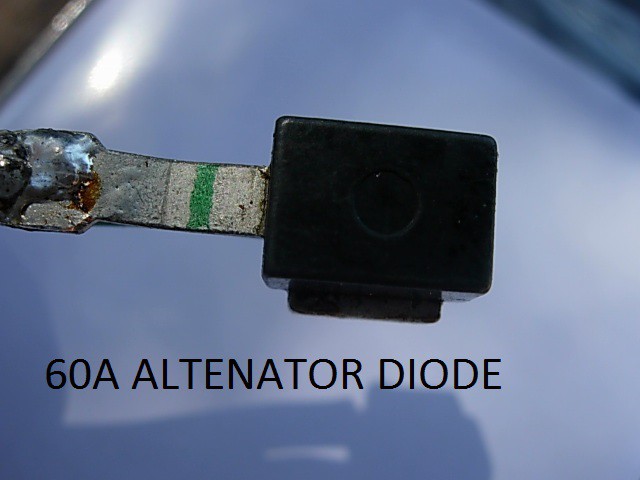
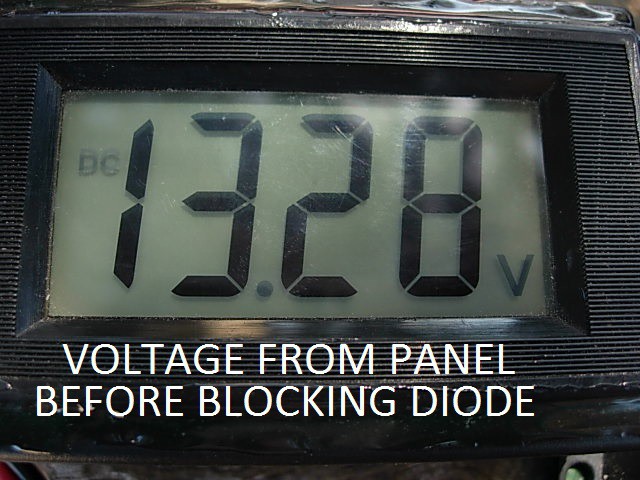
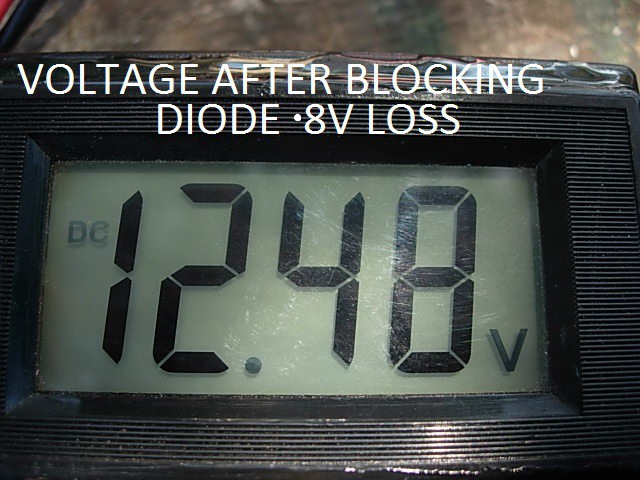
I never thought that having more than one panel would present so many unforseen problems.
Maybe someone on here could advise how these diodes should be mounted, enclosure, space, material etc.
Cheers,
Peter
Hi Ian
I am still working on my system, as other things had cropped up
T1 Terry had sent me four 15 amp diodes, I have used two of them, and you are welcome to the other two, free of charge, (you must thank T1 Terry)
Just PM me a place to send them
I have no idea, about needing 16 amp, for a 160 watt solar panel
The specs of my 160 watt panel, say that the short circuit amps are only 9.27
I used the two 15SQ45 diodes from Ti Terry, just before my DC/DC charger, (in parallel), to stop any feedback from the 160 watt portable panel, going to the 300 watt roof solar panel
I have previously seen, 14.1 amps from my 300 watt solar panel, and from memory, the short circuit amps are suppose to be about 17
They are in a Jiffy box
I am led to believe, but do not quote me, that putting two diodes in parallel, will allow the amps, to be distributed over the two diodes, and give more cross section area of wire
I originally joined the two 15SQ45 diodes in parallel, using the 6mm forked spade terminal, as suggested by Terry, to DeBe
I had placed them in a Jiffy box, but as I was crimping the last wire on, (you have seen my hands), I bent one of the spade terminals
I therefore removed the diodes and used, a more solid 6x10 non insulated eye terminal, 6 being the size of the sq cable you can use, and 10 being the hole diameter
I used two pair of long nose pliers, with lacky band on the handles, (to keep them secure), as a heat sink on the diode wire, while I soldered, un-soldered, and re-soldered them
For my 160 watt portable panel, (the son in law had already given me about five, (pre loved) 12SQ45 (12 amp) diodes, from an old solar panel
I soldered two of these (in parallel), onto the same type of 6x10 non insulated eye terminal, and they are also just before my DC/DC charger, in another Jiffy box
I hope to be able to run both my 300 watt roof, and my 160 watt portable panel (with regulator isolated), through my DC/DC charger in parallel
I realise that I will loose some volts, and some amps, but time will tell if this loss is acceptable to me
I was unaware (until now), about the heat problems of diodes
I shall run my battery down tomorrow morning, and then about noon, switch the solar on, and check for heat
I shall report back
A bit of interesting information I have come across, about blocking/bypass diodes, which may help others in the future
The first two numbers represent the forward amps, which the diode can take, the last two number represent the highest return voltage it will block
12SQ45, 15SQ45, and 20SQ45 diodes all have the same diameter wire, approximately 1.2 to 1.3mm, This is approximately 1.3 sq mm
I thought that two of them in parallel, would give me 2.6 sq mm, (which would not be too far off some of the Jayco wire.
Hope that this info is useful to someone in the future
I also hope that if any Electricians see anything wrong, in what I have done, then they will speak up, I would not like to give out false information to anyone
I have a major rewire job on the van tomorrow, fitting a solar controller that is at least twice the size of what is being replaced. All this in a caravan park.
I was planning on putting the by-pass diode in the terminal box attached to the solar panel. Terry is ending me some diodes as well, however I am worried about delivery time, so I will take you up on your offer, as I will need the diodes as soon as possible.
I assume you got my pm the other day.
Hi
Diodes get hot, the makers know that as well. The max amp rating is usually with a minimum lead length of half that supplied, to dissipate heat. If you solder them to a metal terminal and to a heavy wire they will both act as heat sinks. Look at those diodes in the pictures above in the terminal box from the factory. That is the standard practice. It is wise to fit heavier rated diodes if possible but they get just as hot as the smaller ones. The wattage to dissipate is the same 0.7V x 6.66 A = 4.66 W> Using schotzzy ?? diodes gives only 0.4V drop for 2.66W.
In De's case I believe the conditions may have changed a bit between the readings as the current will not disappear in the diode. The voltage has varied a bit and so did the current. Perhaps the extra 0.7v drop. Those meters are not precision either for small readings, not being critical. Good to see real readings.
Jaahn
Ian, once again apologise that I did not spot your PM
Have just replied to the PM, where you gave me an address, I used the name which is in your profile, c/o to the address
I have also gave the tracking number, the Post Office gave to me
Post Office is not sure if they will be delivered tomorrow or Monday
They are wrapped in the same bubble wrap, I received them in
Once again I thank T1 Terry, for giving me four 15SQ45 diodes, free of charge
I have used two, and the other two, have now gone to a good caravan, owned by a Grey Nomad forum member
Thanks for that information Jaahn, it is appreciated
I was unaware, that I was supposed to snip the wire of the diodes to half their length
It is very overcast at the moment, and rain is expected (80% chance), for the next few days
When the sun starts shining, I shall go and measure the temperature of the diodes, if they get hot I shall rehash everything
-- Edited by Jaahn on Friday 12th of October 2018 04:03:23 PM
Hi Jaahn
These Fitter type boys, you can not take them anywhere these days
I done it all wrong, and used much too much solder, so thanks for that tip, it will come in handy next time
I did have normal (for me) 6 inch long nose pliers as a heat sink, while I was soldering, and the diodes are working
I had run my batteries down to 12.6 volts but it is very overcast (can not see any blue sky)
From 300 watt roof solar, I managed to get around 5 amps at the inlet of the diodes, and around 4.6 amps at the inlet of my DC/DC charger
I can live with this, as I was getting nearly 6 amps at the battery
With an ambient temperature of 21ºC I saw no more than 34ºC at the body of the diodes and no more than 28ºC at the eye terminals, with 5 amps going through
I did not think that it was worth my time setting up the portable solar panel, until we see the sun, in a few days time
I shall advise if I have any problems, with my set up
Below is a picture on how I fitted the diodes which I had to remove from the Jiffy box, to pull up, (upside down), into the open to measure the amps and heat
Looking at the underside, you can see how much solder I had used, and the bent wire of the diode, happened because of my clumsy hands, pulling it out of the Jiffy box
The eye terminals are 6/10 non insulated so quite a big heat sink
I think I will go with 3 Diodes in parallel to share the load on each panel , as I have 4 x 160W panels. Have ordered 40 of the diodes & will probably take upto 30 days to arrive.
-- Edited by DeBe on Friday 12th of October 2018 07:08:41 PM