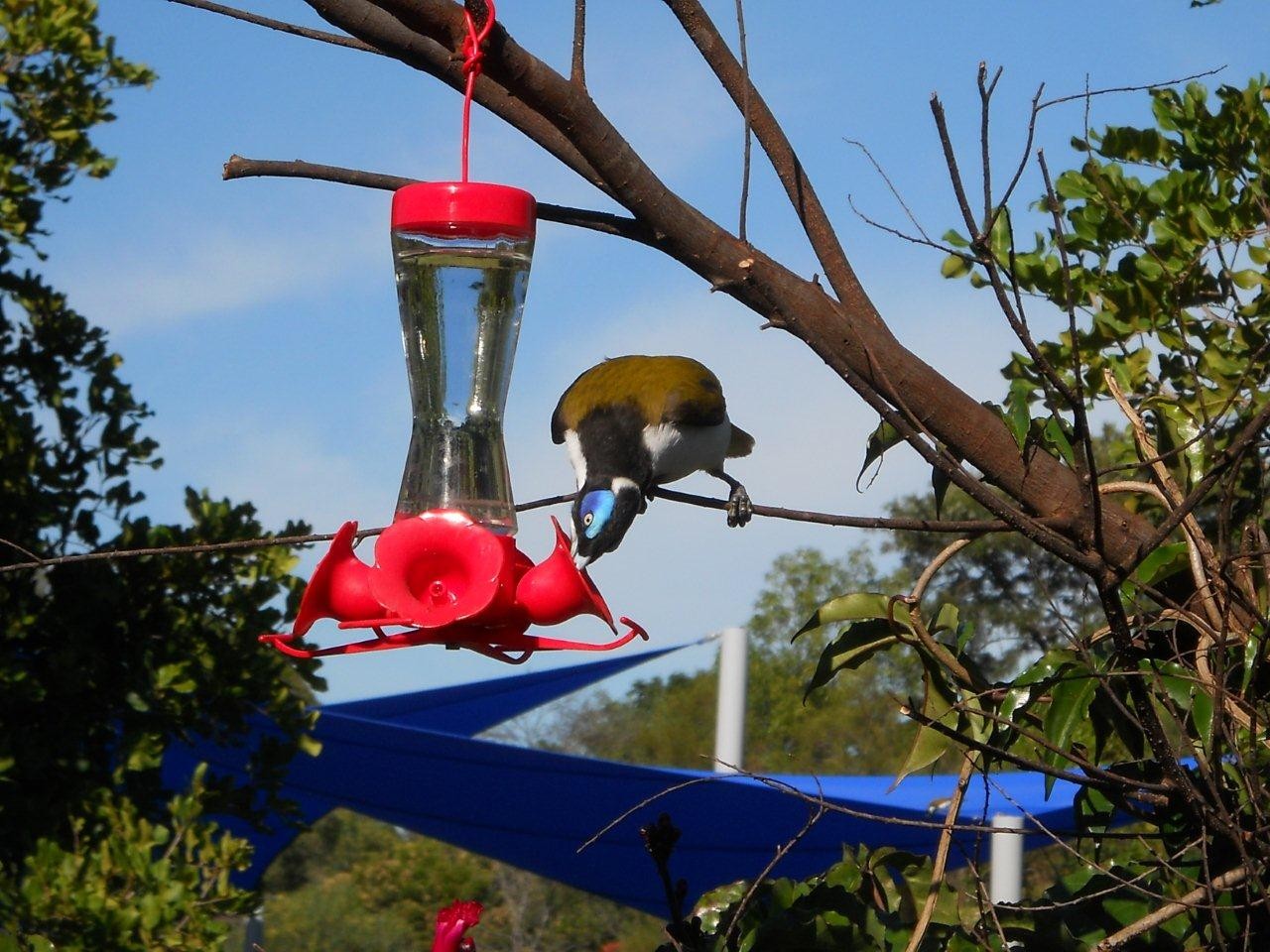
-- Edited by Dougwe on Thursday 7th of June 2018 04:46:46 PM
iana said
06:43 PM Jun 7, 2018
Doug that is not so funny, we have a friend in Brisbane who has families of different birds that come to their house for a feed, these are wild birds, but they come into the lounge, or fly down the passage ways, if the fly screens are closed, its bye bye fly screen. She feeds them by hand, and they take the food back to the nest for the young ones. As far as I know the birds are Kookaburras, Butcher Birds, Yellow crested ****ies and lorikets.
Rather than great numbers of birds, they are families which have hatched out around them, all of course have names.
Mike Harding said
08:53 PM Jun 7, 2018
Very good :)
Having said that... *DON'T FEED NATIVE ANIMALS*
Happywanderer said
10:02 AM Jun 8, 2018
My birds will enjoy me returning after a week on the Gold Coast.
Their new toy is a birdbath. They love it.
moamajohn said
10:47 AM Jun 8, 2018
Up here in Echuca we have a kooka that calls in at 5 ish in the arvo.If wifey doesn,t come out in the time frame that suits the kooka he/she lands on the window sill and belts the window with his beak !!
rockylizard said
11:34 AM Jun 8, 2018
Gday...
I find that maggies are a very friendly lot ...
Sorry to have caused angst and hand-wringing.
Best to remove the offensive subjects and remove myself to the naughty room.
cheers - John
-- Edited by rockylizard on Friday 8th of June 2018 04:42:32 PM
Mike Harding said
01:03 PM Jun 8, 2018
"Just a few little breadcrumbs won't hurt them ... or will it?" https://www.ehp.qld.gov.au/wildlife/livingwith/feeding_native_animals.html
And a delightful short film which shows what a delicate balance the natural world is: "How Wolves Change Rivers" https://www.youtube.com/watch?v=ysa5OBhXz-Q
Don't feed the birds and animals - they don't need you to, you're doing it for your benefit, not theirs.
Blues Man said
04:26 PM Jun 8, 2018
After viewing that vid Mike , just reinforces my thoughts on how beautiful nature is and works.
Mike Harding said
06:48 PM Jun 8, 2018
Blues Man wrote:
After viewing that vid Mike , just reinforces my thoughts on how beautiful nature is and works.
Agreed. Isn't it just amazing how all the connections occur and they keep the "system" in balance.
It seems whenever we humans step in all we do is stuff it up.
Don't feed the birds and animals - they don't need you to, you're doing it for your benefit, not theirs.
Professor Darryl Jones has a whole different view. He has recently published in the area, 1st March this year. Been feeding a magpie pair in the kitchen for several years. They turn up with their latest brood every year. Just helped GGKids establish new regular visitors to their home in the middle of a major city suburb.
Also have several possums and sugar gliders turn up every night to see if anything left out for them.
Iza
Dougwe said
10:13 AM Jun 9, 2018
rockylizard wrote:
Gday...
I find that maggies are a very friendly lot ...
Sorry to have caused angst and hand-wringing.
Best to remove the offensive subjects and remove myself to the naughty room.
cheers - John
-- Edited by rockylizard on Friday 8th of June 2018 04:42:32 PM
Maybe I should join you Rocky, as I put the original post up anyway, in fun. I got a smile out of it and thought someone else might too. Instead it seems to have strirred the pot a little. I better get the satnav out to find my way to the naughty room as I have not been sent there for a while.
Santa said
10:15 AM Jun 9, 2018
I have no problem with feeding birds, we do it involuntarily each year when the little buggers raid our grape vines and fruit trees.
We also feed at other times and provide a (much appreciated) bird bath during the warmer months, birds in our garden are a delight.
"Feeding birds is absolutely normal and extremely popular around the world. The only place in the world where it's opposed anywhere is in Australia, yet the proportion of people feeding the birds is about the same"
Australians really do get some strange self righteous notions into their little (nanny state) heads at times.
KJB said
10:26 AM Jun 9, 2018
Last sentence is "spot on..."
iana said
10:52 AM Jun 9, 2018
You didn't tell us you were going away for ten weeks camping!
Just a few extracts from an interesting paper about feeding wild birds - however I suspect I'm banging my head against a brick wall with some people.
Incidentally; you do all follow the good professor's *Golden Rules* for bird feeding don't you...?
---
Darryl's golden rules for bird feeding: Cleanliness. Sweep up any left overs and spray with a mix of water and vinegar. Dry and then place new feed. Do this daily.
Provide a Snack. Not a meal. Just a little bit of food goes a long, long, way.
Never feed birds away from your home. Professor Jones' enthusiasm for bird feeding stops at the front gate. Feeding bread to the ducks and swans at the park is a definite no-no.
---
http://www.publish.csiro.au/mu/pdf/MUv111n2_ED
The best known of these was the conjunctivitis epidemic among American House Finches (Carpodacus mexicanus ) in the eastern USA, a phenomenon initially reported among birds visiting feeders (Dhondt et al . 2001 ). The subsequent monitoring of the spread of the disease was achieved by recruiting large numbers of feeder operators in one of the most effective examples of large-scale citizen science (Hochachka and Dhondt 2000 ). This army of motivated participants enabled researchers to follow the outbreak through its peak c . 2004 (when ~15% of the eastern population of House Finches were infected) and the later plateau phase (Cornell La
---
Remarkably similar characteristics surround the discovery and monitoring of the protozoan disease Trichomoniasis gallinae in the UK, which was declared an epidemic in 2005 (Robinson et al . 2010 ). Unlike the conjunctivitis, Trichomoniasis is fatal for most infected Common Green finch ( Chloris chloris ) and Common Chaffinch ( Fringilla coelebs ), and has resulted in declines of affected populations of 35 and 21% respectively, between 2007 and 2009 in the UK (Robinson et al . 2010 ). Again, the role of feeders appeared to be somewhat equivocal. Although there is no doubt that infections are more likely owing to the cramming of birds at feeding stations, the highly gregarious social behaviour of the two main species suggested that any infection was likely to spread quickly. Less-social British finches, though also susceptible, have been far less affected (Robinson et al . 2010 ). Tricho- moniasis has often been detected in wild populations of many species, but outbreaks appear to have short durations (Real et al . 2000 ).
---
A significant feature of bird feeding as practiced in Australia is the heavy provision of meat as the main food (Rollinson et al . 2003 ). With larger, predatory birds, such as Australian Magpies ( Cracticus tibicen ), butcherbirds ( Cracticus spp.) and Pied Cur- rawongs ( Strepera graculina ) being among the most frequent and favoured visitors to feeding stations (Rollinson et al . 2003 ; Ishigame and Baxter 2007 ), a wide variety of meats, such as mince, sausage and organs, are used to attract these species. This raises several issues: risk of disease associated with communal feeding, the potential for bacterial spread owing to feeding on raw meats, as well as the potential nutritional effect of heavy use of fatty processed foods. Unfortunately, we know very little about any of these issues, although one experimental study of captive Magpies found consistently raised cholesterol levels in birds eating a diet of processed sausage meat (Ishigame et al . 2006 )
---
Although little is known about the negative effects of feeding birds on their ecosystems, the fundamental influence of food supply on the lives of animals has long been appreciated, largely through many carefully conducted supplementary feeding experiments (see Martin 1987 ; Robb et al . 2008 ). These studies have explored, for example, the influence of the timing, quantity and quality of food provisioning on hatching and laying dates, clutch- size, and survival of chicks and fledglings (Boutin 1990 ; Newton 1998 ). This work on a huge variety of species means that we can now be reasonably certain about some important likely outcomes of feeding. First, wintering birds supplied with additional foods have greatly enhanced survival, and second, food supplementation almost always advances the key reproduction dates: laying, hatching, fledging and, often, re-nesting (Chamberlain et al . 2005 ; Fuller et al . 2008 ). Thus, supplemented birds typically breed earlier and more often. However, evidence for direct benefits to fitness, such as producing larger clutches and enhancing hatching survival is far less obvious (Robb et al . 2008 ). In an important recent experiment conducted in the UK, Great Tits ( Parus major ) and Blue Tits ( Cyanistes caeruleus ) were provided with supplementary foods over three consecutive breeding seasons (Harrison et al . 2010 ). This unusually long duration for the experiment found that whereas laying date was earlier and incubation duration reduced as expected, clutch sizes and hatching success were actually lower than unfed populations. The importance of these findings, acknowledged directly by the researchers (Harrison et al . 2010 ), was that these breeding parameters closely resembled what had been noted among urban populations of several species of British birds, many of which habitually use feeders (Chamberlain et al . 2009 ). Given the assumption that feeders enhance urban bird populations, these are sobering discoveries, although the mechanisms are far from being understood.
---
blaze said
01:12 PM Jun 9, 2018
Mike Harding wrote:
And a delightful short film which shows what a delicate balance the natural world is: "How Wolves Change Rivers" https://www.youtube.com/watch?v=ysa5OBhXz-Q
Don't feed the birds and animals - they don't need you to, you're doing it for your benefit, not theirs.
and that's the very reason they should stop baiting dingos
cheers
blaze
Izabarack said
02:32 PM Jun 9, 2018
blaze wrote:
and that's the very reason they should stop baiting dingos
Yes, like to see more action against wild dogs, feral cats, and brumbies.
Iza
Mike Harding said
07:05 PM Jun 9, 2018
Izabarack wrote:Yes, like to see more action against wild dogs, feral cats, and brumbies.
Feral cats, especially, are an absolute menace killing *millions* of native animals each year. Go for a walk in the bush at night with an LED torch - you'll soon find one.
I regularly shoot them in the bush although they are hard to hunt. A major problem is that firearms are not permitted in National Parks and these have become havens for both feral cats and dogs particularly in north east Victoria in the Alpine NP.
JA2340 said
08:01 PM Jun 9, 2018
Cannot but agree with Mike and Iza about the feral cats!
We regularly get cats dumped at our place (just half hour out of town) and they do untold damage to the local wren/pidgeon/wagtail population.
We set a trap for them, take the catch to the local pound where they are scanned for a chip (and if chipped, the owners are charged a fee for return) and euthanised if not chipped.
Not having a firearms licence, I'll not try shooting them.
ALL cat and dog owners should be required to have them chipped, and to have them neutered (unless a registered breeder) and pay huge fees to retrieve any that are found outside of their enclosures!
[/rant]
Roy E said
06:12 PM Jun 14, 2018
Guru, I love the pic of your kookaburras and magpies and I love feeding the local birds. I often feed the local magpies and they don't attack me during breeding season When I lived at Mount Nebo, I fed many types of local birds there and loved their company. Now down at Bracken ridge, I have a sugar-water feeder to feed a local family of banana birds. Roy.
PS. Feeding an albatross at Kaikoura with one of my unwanted fish.
-- Edited by Dougwe on Thursday 7th of June 2018 04:46:46 PM
Rather than great numbers of birds, they are families which have hatched out around them, all of course have names.
Very good :)
Having said that... *DON'T FEED NATIVE ANIMALS*
Their new toy is a birdbath. They love it.
Gday...
I find that maggies are a very friendly lot ...
Sorry to have caused angst and hand-wringing.
Best to remove the offensive subjects and remove myself to the naughty room.
cheers - John
-- Edited by rockylizard on Friday 8th of June 2018 04:42:32 PM
"Just a few little breadcrumbs won't hurt them ... or will it?"
https://www.ehp.qld.gov.au/wildlife/livingwith/feeding_native_animals.html
"Let nature feed itself"
https://www.wires.org.au/wildlife-info/wildlife-factsheets/let-nature-feed-itself
And a delightful short film which shows what a delicate balance the natural world is:
"How Wolves Change Rivers"
https://www.youtube.com/watch?v=ysa5OBhXz-Q
Don't feed the birds and animals - they don't need you to, you're doing it for your benefit, not theirs.
After viewing that vid Mike , just reinforces my thoughts on how beautiful nature is and works.
Agreed. Isn't it just amazing how all the connections occur and they keep the "system" in balance.
It seems whenever we humans step in all we do is stuff it up.
"How Wolves Change Rivers"
https://www.youtube.com/watch?v=ysa5OBhXz-Q
Professor Darryl Jones has a whole different view. He has recently published in the area, 1st March this year. Been feeding a magpie pair in the kitchen for several years. They turn up with their latest brood every year. Just helped GGKids establish new regular visitors to their home in the middle of a major city suburb.
Also have several possums and sugar gliders turn up every night to see if anything left out for them.
Iza
Maybe I should join you Rocky, as I put the original post up anyway, in fun. I got a smile out of it and thought someone else might too. Instead it seems to have strirred the pot a little. I better get the satnav out to find my way to the naughty room as I have not been sent there for a while.
I have no problem with feeding birds, we do it involuntarily each year when the little buggers raid our grape vines and fruit trees.
We also feed at other times and provide a (much appreciated) bird bath during the warmer months, birds in our garden are a delight.
http://www.abc.net.au/news/2018-02-05/this-ecologist-will-make-you-feel-better-about-feeding-birds/9383686
"Feeding birds is absolutely normal and extremely popular around the world. The only place in the world where it's opposed anywhere is in Australia, yet the proportion of people feeding the birds is about the same"
Australians really do get some strange self righteous notions into their little (nanny state) heads at times.
Last sentence is "spot on..."
You didn't tell us you were going away for ten weeks camping!
Just a few extracts from an interesting paper about feeding wild
birds - however I suspect I'm banging my head against a brick wall
with some people.
Incidentally; you do all follow the good professor's *Golden Rules*
for bird feeding don't you...?
---
Darryl's golden rules for bird feeding:
Cleanliness. Sweep up any left overs and spray with a mix of water
and vinegar. Dry and then place new feed. Do this daily.
Provide a Snack. Not a meal. Just a little bit of food goes a long,
long, way.
Never feed birds away from your home. Professor Jones' enthusiasm for
bird feeding stops at the front gate. Feeding bread to the ducks and
swans at the park is a definite no-no.
---
http://www.publish.csiro.au/mu/pdf/MUv111n2_ED
The best known of these was the conjunctivitis epidemic among
American House Finches (Carpodacus mexicanus ) in the eastern USA, a
phenomenon initially reported among birds visiting feeders (Dhondt et
al . 2001 ). The subsequent monitoring of the spread of the disease
was achieved by recruiting large numbers of feeder operators in one
of the most effective examples of large-scale citizen science
(Hochachka and Dhondt 2000 ). This army of motivated participants
enabled researchers to follow the outbreak through its peak c . 2004
(when ~15% of the eastern population of House Finches were infected)
and the later plateau phase (Cornell La
---
Remarkably similar characteristics surround the discovery and
monitoring of the protozoan disease Trichomoniasis gallinae in the
UK, which was declared an epidemic in 2005 (Robinson et al . 2010 ).
Unlike the conjunctivitis, Trichomoniasis is fatal for most infected
Common Green finch ( Chloris chloris ) and Common Chaffinch (
Fringilla coelebs ), and has resulted in declines of affected
populations of 35 and 21% respectively, between 2007 and 2009 in the
UK (Robinson et al . 2010 ). Again, the role of feeders appeared to
be somewhat equivocal. Although there is no doubt that infections are
more likely owing to the cramming of birds at feeding stations, the
highly gregarious social behaviour of the two main species suggested
that any infection was likely to spread quickly. Less-social British
finches, though also susceptible, have been far less affected
(Robinson et al . 2010 ). Tricho- moniasis has often been detected in
wild populations of many species, but outbreaks appear to have short
durations (Real et al . 2000 ).
---
A significant feature of bird feeding as practiced in Australia is
the heavy provision of meat as the main food (Rollinson et al . 2003
). With larger, predatory birds, such as Australian Magpies (
Cracticus tibicen ), butcherbirds ( Cracticus spp.) and Pied Cur-
rawongs ( Strepera graculina ) being among the most frequent and
favoured visitors to feeding stations (Rollinson et al . 2003 ;
Ishigame and Baxter 2007 ), a wide variety of meats, such as mince,
sausage and organs, are used to attract these species. This raises
several issues: risk of disease associated with communal feeding, the
potential for bacterial spread owing to feeding on raw meats, as well
as the potential nutritional effect of heavy use of fatty processed
foods. Unfortunately, we know very little about any of these issues,
although one experimental study of captive Magpies found consistently
raised cholesterol levels in birds eating a diet of processed sausage
meat (Ishigame et al . 2006 )
---
Although little is known about the negative effects of feeding birds
on their ecosystems, the fundamental influence of food supply on the
lives of animals has long been appreciated, largely through many
carefully conducted supplementary feeding experiments (see Martin
1987 ; Robb et al . 2008 ). These studies have explored, for example,
the influence of the timing, quantity and quality of food
provisioning on hatching and laying dates, clutch- size, and survival
of chicks and fledglings (Boutin 1990 ; Newton 1998 ). This work on a
huge variety of species means that we can now be reasonably certain
about some important likely outcomes of feeding. First, wintering
birds supplied with additional foods have greatly enhanced survival,
and second, food supplementation almost always advances the key
reproduction dates: laying, hatching, fledging and, often, re-nesting
(Chamberlain et al . 2005 ; Fuller et al . 2008 ). Thus,
supplemented birds typically breed earlier and more often. However,
evidence for direct benefits to fitness, such as producing larger
clutches and enhancing hatching survival is far less obvious (Robb
et al . 2008 ). In an important recent experiment conducted in the
UK, Great Tits ( Parus major ) and Blue Tits ( Cyanistes caeruleus )
were provided with supplementary foods over three consecutive
breeding seasons (Harrison et al . 2010 ). This unusually long
duration for the experiment found that whereas laying date was
earlier and incubation duration reduced as expected, clutch sizes and
hatching success were actually lower than unfed populations. The
importance of these findings, acknowledged directly by the
researchers (Harrison et al . 2010 ), was that these breeding
parameters closely resembled what had been noted among urban
populations of several species of British birds, many of which
habitually use feeders (Chamberlain et al . 2009 ). Given the
assumption that feeders enhance urban bird populations, these are
sobering discoveries, although the mechanisms are far from being
understood.
---
and that's the very reason they should stop baiting dingos
cheers
blaze
Yes, like to see more action against wild dogs, feral cats, and brumbies.
Iza
Feral cats, especially, are an absolute menace killing *millions* of native animals each year. Go for a walk in the bush at night with an LED torch - you'll soon find one.
http://www.environment.gov.au/biodiversity/invasive-species/feral-animals-australia/feral-cats
I regularly shoot them in the bush although they are hard to hunt. A major problem is that firearms are not permitted in National Parks and these have become havens for both feral cats and dogs particularly in north east Victoria in the Alpine NP.
We regularly get cats dumped at our place (just half hour out of town) and they do untold damage to the local wren/pidgeon/wagtail population.
We set a trap for them, take the catch to the local pound where they are scanned for a chip (and if chipped, the owners are charged a fee for return) and euthanised if not chipped.
Not having a firearms licence, I'll not try shooting them.
ALL cat and dog owners should be required to have them chipped, and to have them neutered (unless a registered breeder) and pay huge fees to retrieve any that are found outside of their enclosures!
[/rant]
Roy.
PS. Feeding an albatross at Kaikoura with one of my unwanted fish.